
Properly designed modern roundabouts can be an effective tool for reducing congestion and traffic injuries at intersections. While roundabouts are becoming more common on our roadways, they are often misunderstood as dangerous or as a one-for-one replacement for all signalized intersections. Modern roundabouts are one of many tools available to safety professionals that:
- Slow vehicles down: when crashes do happen, they are less severe.
- Properly position vehicles: motorists can see all traffic in and near the roundabout, including people walking and biking, resulting in less crashes.
- Ensure safe vehicle yielding: both before entering and after exiting the roundabout, providing opportunities for people walking/biking to cross legs of the roundabout and prioritizing vehicular movements of vehicles within the roundabout.
- Provide safe passage for people walking and biking: across each leg of the roundabout with ADA amenities such as raised crosswalks, curb ramps, and/or possibly pedestrian beacons or signals.
While newly installed roundabouts can involve a short adjustment period as drivers learn a new traffic pattern, their long-term purpose is clear: slower speeds and safer roads for everyone. In fact, roundabouts offer significant safety benefits:
- When a traditional two-way stop intersection is replaced by a roundabout, fatal and injury crashes are reduced by 82%1.
- When a signalized intersection is replaced, fatal and injury crashes are reduced by 78%2.
Roadway professionals study traffic movements, topography, land availability, and corridor context before proceeding with a roundabout recommendation. Some older roundabouts are also getting enhancements to better address the needs of all roadway users.
The Road Wizard video explains how different users navigate roundabouts and addresses common safety concerns.
Roundabout Quick Tips
- When approaching a roundabout, slow down and yield to traffic in all lanes of the roundabout.
- Do not change lanes inside a roundabout. Look for signage and choose your lane prior to entering the roundabout.
- Use your signal when exiting a roundabout.
- Yield to pedestrians and cyclists when entering and exiting a roundabout.
Types of Roundabouts
Modern roundabouts come in many shapes, sizes, and designs to fit the local community/neighborhood context. All roundabouts share the following features:
- Central island – The raised area in the center of a roundabout around which traffic circulates.
- Splitter Island – The raised or painted area on an approach used to separate entering from existing traffic, deflect and slow entering traffic, and provide space for pedestrians crossing the road in two stages.
- Circulatory roadway – The curved path used by vehicles to travel counterclockwise around the center island.
- Apron – The mountable portion of the central island adjacent to the circulatory roadway. Used on smaller roundabouts to accommodate the wheel tracking of large vehicles.
- Yield line – A pavement marking used to mark the point of entry from an approach into the circulatory roadway and is generally marked along the inscribed circle. Entering vehicles must yield to any circulating traffic coming from the left before crossing this line into the circulatory roadway.
- Accessible pedestrian crossings – The crossing location is set back from the yield line, and the splitter island is cut to accommodate pedestrians, wheelchairs, strollers, and bicycles. These should be provided at all roundabouts.
- Bicycle treatment – Provides bicyclists the option of traveling through the roundabout either by riding or walking with bicycle, depending on the individual’s level of comfort.
- Landscaping buffer – Provided at most roundabouts to separate vehicular and pedestrian traffic and encourage pedestrian crossings only at the designated locations. Also significantly improves intersection aesthetics.
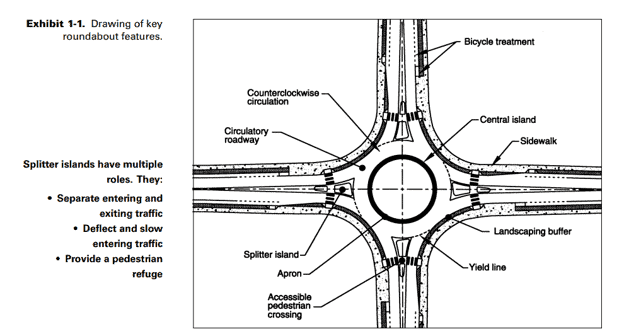
Source: Roundabouts: An Informational Guide (FHWA-RD-00-067)
Common roundabout types
- Mini roundabout – Generally has an inscribed circle diameter (ICD) of 45 ft to 80 ft, splitter islands, an entirely traversable central island for trucks or other large vehicles, and one circulating lane. Reduces the footprint of the intersection, and the roundabout can often be retrofitted within existing intersection footprints.
- Compact roundabout – Generally has an ICD between 80 ft and 100 ft, with a portion of the central island being non-traversable, and one circulating lane.
- Single-lane roundabout – Generally has an ICD range of 100 ft to 130 ft, a non-traversable central island that may include a truck apron, and one circulating lane.
- Multilane roundabouts – These generally have an ICD between 150 ft to 200 ft, a non-traversable central island that may include a truck apron, and two or more circulating lanes.
Other roundabout types
- Turbo roundabout – A specialized multi-lane roundabout with raised lane dividers that discourages lane changing on the approach and within the roundabout.
- Dogbone/dumbbell/peanut roundabouts – Two connecting roundabouts joined directly by a narrow “waist” in the middle.
- Modular roundabout – A specialized roundabout that incorporates prefabricated materials to reduce excavation, paving and drainage work, environmental impacts, utility and right-of-way impacts, construction duration, and cost. The modular material is typically used for the central island and splitter islands but may also be used for outside curbing. The material is glued or anchored on top of existing pavement. In addition to these custom-made materials, modular roundabouts employ striping and may include quick-build curbs and flex-posts to delineate vehicle paths.
Neighborhood traffic circles are typically located at intersections of local or residential streets to promote traffic calming. Like mini roundabouts, they are often retrofits to existing intersections, but they differ from roundabouts in several ways, including:
- May use yield, stop, or no control on one or more approaches.
- The central island is non-traversable.
- Often do not have splitter islands on the approaches.
- Some neighborhood traffic circles allow left-turning vehicles to pass to the left of the central island.

Case Study: Washtenaw County Road Commission
Washtenaw County Road Commission (WCRC) conducts annual monitoring of intersections, primarily on two-lane high-speed county roads. This monitoring program includes evaluation of potential candidates for roundabouts or traffic signals based of crash history and delay at each location. There are now over 30 roundabouts in Washtenaw County. The first roundabout in Washtenaw County was installed in 2003. Since then, the number of intersection crashes resulting in any injury has decreased by nearly 40% across the county. WCRC found that roundabouts with a diameter of 100 to 110 feet have the best performance in terms of safety and operations. WCRC continues to monitor locations with field visits and crash reports. More information on roundabouts in Washtenaw County can be found on the WCRC website.
Case Study: Road Commission for Oakland County
The Road Commission for Oakland County (RCOC) is one of the agencies leading the way in the use of roundabouts – which can increase capacity (the amount of traffic that can flow through) from 30-50% and help to ease traffic congestion. One example is the roundabout at M-5/Pontiac Trail/Martin Parkway.
This is a high-volume intersection, where a state highway dead-ends into a county road. We actually built this roundabout, in part, as a way to deal with all the serious injury/fatality crashes that were occurring at the intersection when it was signalized. People would come cruising down M-5 at 60-plus miles an hour and not be able to stop at the intersection. While that remains a problem today, the design of the roundabout helps to slow them down and we are, at least, having no fatalities and few serious injury crashes. So, this roundabout has accomplished what it was intended to do. Immediately following our ribboncutting ceremony to open that roundabout, an Oakland County Sheriff’s deputy pulled a couple of us aside and thanked us for building the roundabout. He said he was getting very tired of having to respond to fatalities at the previous traffic signal at the intersection. There have not been any fatalities there since the roundabout was built in 2011.
-Craig Bryson, Senior Communications Manager, RCOC
More Resources
- U.S. Department of Transportation Federal Highway Administration shares more information on roundabouts.