
Since the beginning of the pandemic, we are all spending more time at home. This lifestyle has shifted and accelerated many of our priorities as individuals, communities, and as a region.
One example is access to broadband. We have known for years that this is a crucial component of our region’s infrastructure, but in the days of virtual classrooms and meetings, the need for broadband has increased exponentially. Whether it is school, work, shopping, or entertainment, we need broadband (preferably the high-speed variety) for so much of what we do.
This brings us to SEMCOG’s Broadband and Availability Usage Tool, which we were pleased to launch last year. With a range of functions, it displays digital connectivity in terms of residential broadband availability and usage.
Broadband availability shows service areas by maximum advertised internet speed and by number of broadband providers. Internet use is mapped by census block group, and you can view usage data by age, race/ethnicity, and household income. You can also display data by county, school district, community, census tract, intermediate school district, and block group. A complementary function the tool provides is the ability to display Wi-Fi hotspots and school locations throughout the region. The demographic data has recently been updated to 2015- 2019 American Community Survey (ACS) Data.
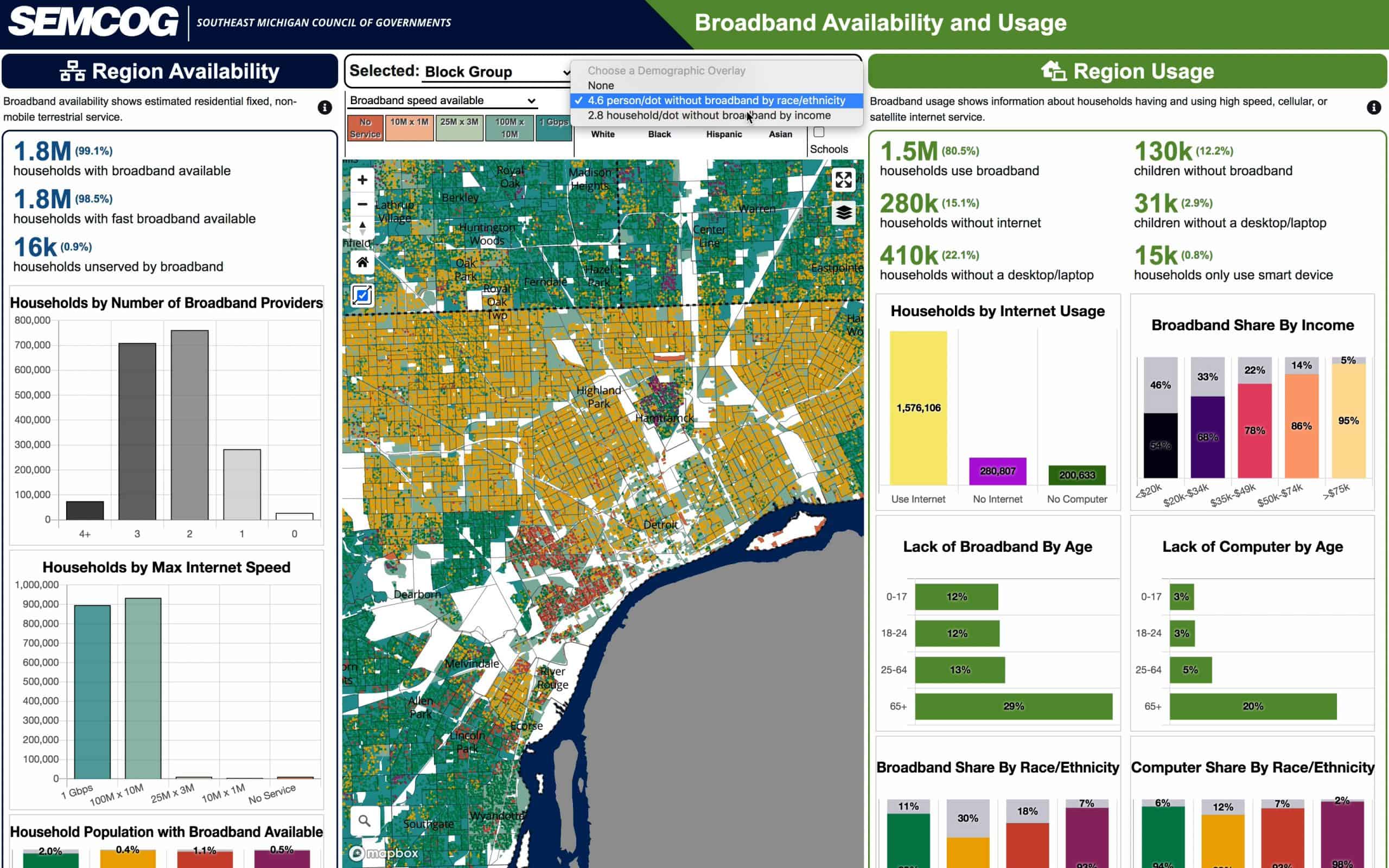
Whether you are an elected official, local government employee, educator, businessperson, parent, student, or engaged citizen, this tool can help you answer questions that may influence your decision-making. For example:
- Is broadband service available to all households?
- Where broadband is not available, what is the magnitude, and which population groups are affected the most?
- What might be some of the reasons for not using broadband other than availability?
- No computer
- Use smart phone instead or decide don’t need it
- Few provider and/or bundled options
- Can’t afford it
- Is there equity between racial/ethnic groups and income groups with respect to broadband access?
Whether folks use broadband to work from home or stream the latest Netflix series, this tool can help you make informed decisions that will best serve all populations. Expanding access to high-speed broadband will strengthen our economy, education system, and overall quality of life in Southeast Michigan; we created this tool to help support that endeavor.
I encourage you to explore for yourself and watch our instructional video (as seen above and also located on the tool’s welcome page) for a detailed orientation on navigating the functionality. Please feel free to reach out to me for more information about the tool. Happy Mapping!
Find the tool at: semcog.org/Broadband
Leave a Reply