
Long-term trends show improvements in traffic crashes and fatality rates in Southeast Michigan and statewide. However, annual traffic crash reporting continues to include a predictable (and preventable) number of deaths. This is unacceptable. This is why Southeast Michigan, in partnership with the State of Michigan, has joined a national effort Toward Zero Deaths on our transportation network. The essential principle is that no amount of preventable human death is acceptable. SEMCOG’s January 2025 “Adopting a Culture of Safety” event explored how Southeast Michigan is moving forward.
This is Part 2 of the event recap. Read Part 1: A Regional Perspective and the Safe System Approach.
The Road Commission for Oakland County’s Safety Story
Gary Piotrowicz, PE, PTOE, Deputy Managing Director/County Highway Engineer, Road Commission for Oakland County (RCOC) presented on how RCOC has created a culture of safety over several decades. RCOC’s safety story is a stunning success.
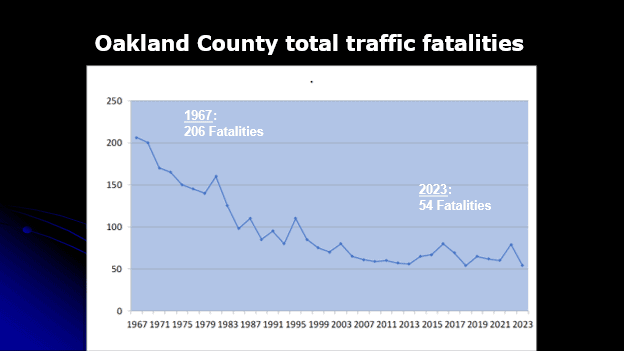
Since 1967, Oakland County’s population has more than doubled. Its vehicle miles traveled (VMT) have more than quadrupled. Its traffic fatalities have also reduced to a quarter of their 1967 level. The fatality rate in Oakland County was 6.8 (per 100 million VMT) in 1967. Today, it is 0.44. This is less than half of Michigan’s rate (1.15), which is lower than the national average (1.35). Oakland County stands out in our region and our nation for its safety success. This, of course, was no accident. The Road Commission marks 1967 as the first strong change in direction toward safety.
The Traffic Improvement Association (TIA), created in 1967, was a new nonprofit with outside support to improve safety. Piotrowicz credited advancements such as the Traffic Crash Analysis Tool (TCAT), among earliest of its kind, in fueling their success.
In 1978, the fledgling safety culture at RCOC was cemented, when the managing director set the top priority in no uncertain terms.
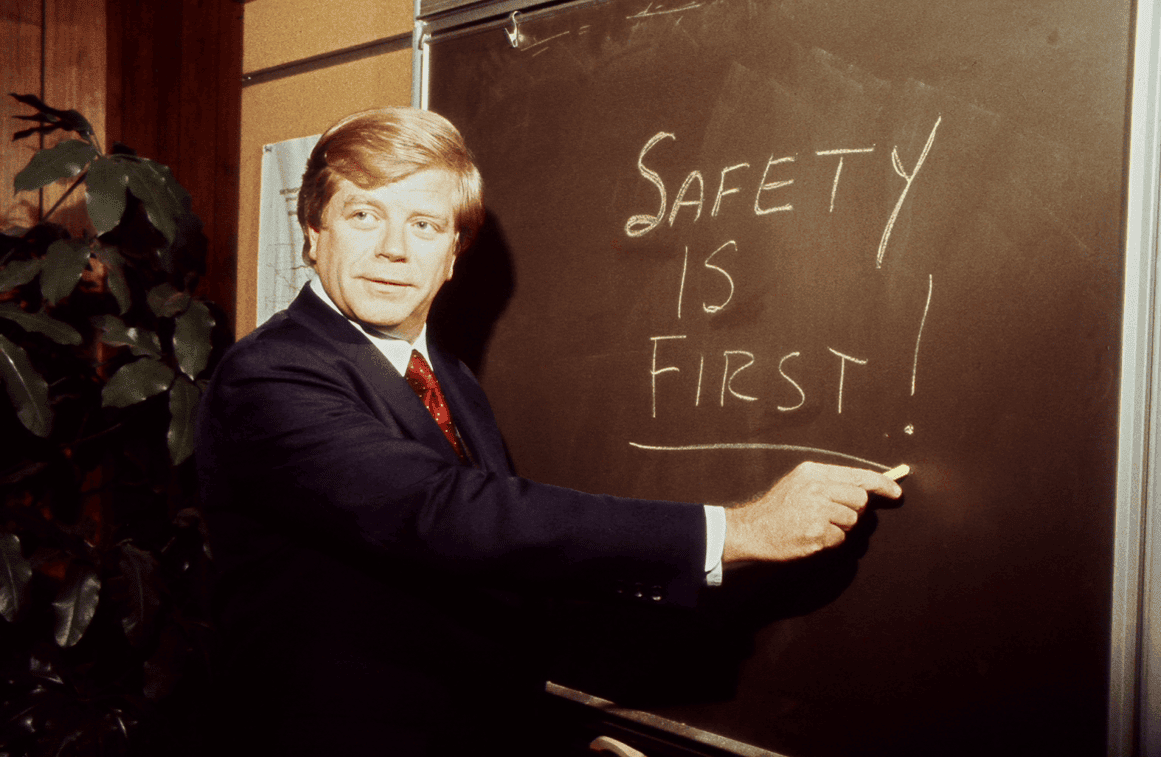
John L. Grubba – Managing Director of RCOC from 1973 to 1992 – with a crystal clear message, “SAFETY IS FIRST!”
Piotrowicz chronicled several decisions and practices that have contributed to RCOC’s success story.
Data-driven decision making
- RCOC has committed to making safety the priority in everything since 1978, including but not limited to:
- Road-project selection
- Road-project design
- Maintenance
- Markings
- Safety reviews of top intersections and links
- Safety audits
- New employee submersion
- According to Piotrowicz, it’s considered a failure if a new hire has not heard “safety” 50 times by noon on day 1.
- Safety measures adopted over the years include:
- Box spans
- LED traffic signals (15 years longer life)
- Adaptive signals
- Traffic signal back plates (visibility)
- Paved shoulders (lane departure)
- High-friction surfaces
- Six-inch edge lines (up from 4 inches, help keep people on the road)
- Sign reflectivity and larger sizes
- Intelligent Transportation Systems (ITS) and connected vehicle technology
- Roundabouts (Oakland County leads Michigan with 44 and more to come), which
- Minimize head-on, t-bone collisions (most frequent producers)
- Induce lower speeds
- Reduce potential conflict points
- Increase capacity
- Improve aesthetics
- Decrease delay by 30-50%
- Technology, including
- Live-stream cameras at 200 locations
- “Smart” / adaptive signal system, connected vehicle technology
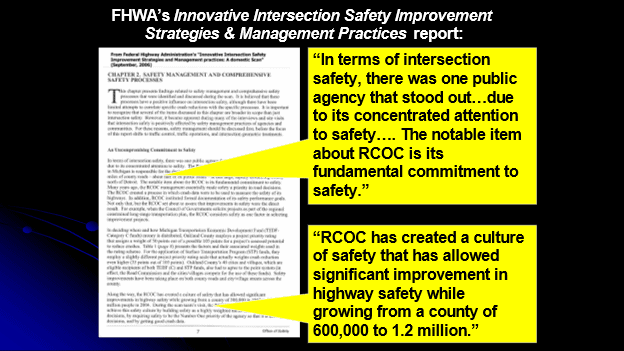
The result of all these efforts? Fewer deaths and glowing reviews from the Federal Highway Administration, for starters.
What are the keys to success in RCOC, according to Piotrowicz?
- Relentless support from the top
- Data drives decisions, not emotions
- Safety is ubiquitous, including employee buy-in
A Student’s Efforts to Improve Safety
Attendees of the January 23 webinar next heard from Evan Zhen, a Canton Township resident trying to make impact on traffic safety. Evan Zhen is a ninth grade student who took up an interest in traffic safety as part of preparing for a middle school civics bee. The charge was to pick an issue in your community and develop solutions for it. Evan Zhen learned about a fatal pedestrian crash that occurred in the middle of night in his community and recognized that it could have been prevented.
“Transportation safety will play a big role in where people choose to live.”
-Evan Zhen, Ninth Grader, Canton Township
He sees safety as a key attribute in where he might choose to live in the future, mentioning his interest in transit and safe options for walking and biking. He believes that prioritizing safety in a community can go a long way, and he is putting forth the effort to prove it. So far, Evan Zhen has engaged with his chamber of commerce, public safety department, and public library. He has also engaged with SEMCOG on the Safe Streets public education program, and we look forward to working with him and Canton Township to support his efforts going forward.
Ann Arbor Moving Together Towards Vision Zero
To kick off her presentation, Suzann Flowers, Transportation Program Manager, City of Ann Arbor, shared a personal anecdote about a close call of her own involving a bus. Flowers regularly uses transit, bike, or walking options within the City of Ann Arbor, where she works. One day, she witnessed the following bus driver’s behaviors:
- Ran stop sign
- Ran red light
- Ran no turn on red
- Did not yield to pedestrian (Suzann)
Fortunately, Flowers did not become a statistic that day. She survived and used this story to emphasize the role that vehicle size plays in a safe system. Specifically, she tries to make sure operators of tall vehicles understand the importance of additional space / distance for the visibility of shorter people.
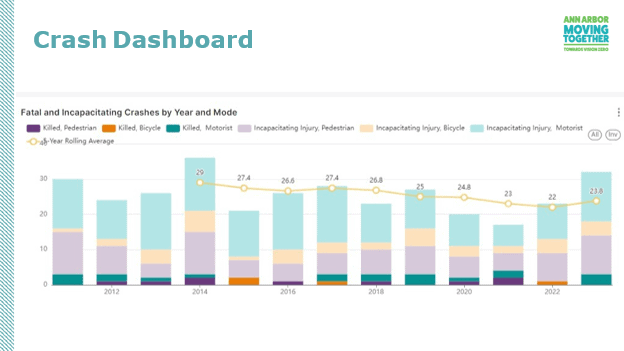
Flowers discussed how the City of Ann Arbor is approaching safety. She credits ongoing city efforts for relatively few fatalities (3-4 per year, still too many as she says), though data does show opportunities to prevent more serious injuries. Activities include:
- Bicycle and pedestrian crashes are monitored and analyzed monthly, annually
- Utilization of a Crash dashboard
- Ongoing development and adoption of planning documents:
- 1990 – Ann Arbor’s first transportation plan
- 2007 – Ann Arbor’s first nonmotorized plan
- 2021 – Ann Arbor’s first Vision Zero Plan
- Support from City Council Policy: Zero Deaths, Zero Emissions
- Analysis and prioritization of a high-injury network (mainly along arterials)
Similar to RCOC, the City of Ann Arbor’s success can be attributed to a comprehensive layering of safety into their culture, including:
- Policy
- All projects are evaluated for speed management from the start
- Multi-lane road evaluation is used to determine where road diets may be viable (“no new lanes”)
- Public right of way is viewed as a finite resource
- Ann Arbor has a 5-foot passing ordinance for bicycles (greater than the 3-foot statewide standard); “Three feet is tight,” especially around large vehicles like trucks and buses
- Engineering:
- Low-cost, quick-build projects including bump outs to reduce exposure for pedestrians and cyclists; encourage speed reduction
- Crosswalks, including rectangular rabid flashing beacons (RRFBs)
- Bike lanes
- Focus on making usy pedestrian areas more suitable for pedestrians
- Devote separate space for cyclists
- Wide pavement markings help reduce the apparent width of travel lanes, and this reduces speeds
- Enforcement
- Trunklines are the worst-performing segments for safety, year-to-year, creating challenges for a City which does not maintain jurisdiction for these roads
- Education / enforcement on targeted corridors is an option when engineering / design solutions are a challenge
- Trunklines are the worst-performing segments for safety, year-to-year, creating challenges for a City which does not maintain jurisdiction for these roads
- Education
- Crosswalk compliance education campaign supported increased usage
- Process
- Safety is used in project scoring
- Created a maintenance of traffic (MOT) specific to bikes
- Project kickoff meetings to ensure safety has a “seat at the table”
- Encouragement
- Provide safe bike parking (pilot program with DDA to repurpose parking space for bikes)
- Bike to Wherever Day Challenge (coincides with Commuter Challenge in May) – 20 stations and 400 participants
- Evaluation
- “Counting peds and bikes like we do with cars”
- Data from counts helps to understand use, needs
- “Counting peds and bikes like we do with cars”
Flowers discussed current challenges in Ann Arbor’s safety story:
- High demand for curb space
- Parking in bike lanes
- People are accustomed to parking at their destination.
- Change is a process, but for most, the expectation can shift to walking a couple blocks
- Reducing on-street parking
- The city is striving to be more intentional with its use of public curb space, including safety
- Speeding
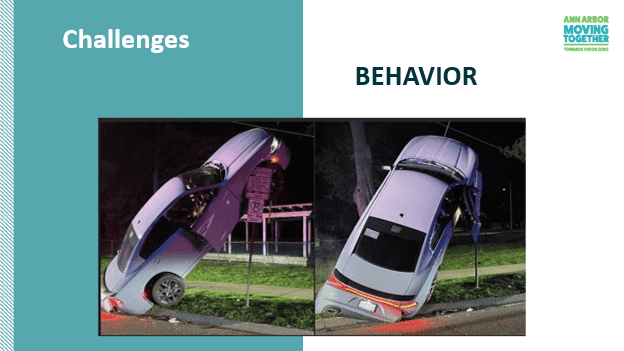
- Regardless of planning and process, some mistakes are just human and unpreventable apart from influencing behavior
Tools and Resources
Jenya Abramovich closed the webinar by sharing several resources and tools that can be used in the practice of adopting a culture of safety, including:
Leave a Reply