
A version of this article was originally featured in SEMCOG’s Economic Development special edition magazine: What’s Our Edge?. Let us know if you would like to request hard copies. Southeast Michigan’s success depends on the unique strengths of its communities, businesses, and educational institutions. Regional cooperation, data-driven strategies, and a skilled workforce are key to driving growth. The Gordie Howe International Bridge, access to water, and education play vital roles in shaping the region’s future. By aligning these assets, the region can achieve greater prosperity, guided by the Economic Development Council’s new strategy.
It has been generally accepted that higher education leads to higher incomes over a lifetime. However, according to a recent national survey, only one in four American adults say it is extremely or very important to have a four-year degree in order to get a well-paying job. While 40% say it is not too, or not at all important. This weakened perception of higher education is an indication of many factors. These include the cost of higher education, fear of college debt, different career pathways not requiring a four-year degree, and perceptions of college as being elitist or “not for me” – especially for potential first generation college students.
These attitudes have led to declining enrollment in four- and two-year colleges, which has serious implications for the region’s economy and future growth. There needs to be a greater awareness of the true value of college, which goes beyond a high paying job. College graduates generally experience higher incomes and job security, lower rates of unemployment and poverty, better health, greater participation in community, volunteering, voting, and donations to charities.
Changing attitudes require an expanding or reframing of the term “college” to mean different opportunities for postsecondary education to reflect changing career pathways.
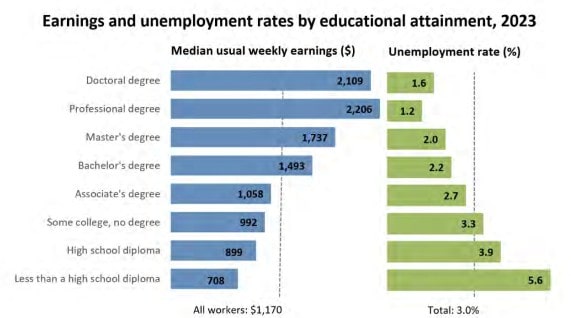
Note: Data are for persons age 25 and over. Earnings are for full-time wage and salary workers. Source: U.S. Bureau of Labor Statistics, Current Population Survey.
What is Postsecondary Education?
While college has traditionally been seen as an institution offering two- or four-year degrees, postsecondary education includes college as well as training certificates, apprenticeships, and credentials. These may be offered as part of a degree or standalone program that is offered by colleges or other training institution such as a labor organization or employer – often in partnership with a college. The broader definition of postsecondary college reflects the reality of employer needs, economic growth, and individual capacity to attend education and training while navigating work, family, and life.
According to President Russ Kavalhuna of Henry Ford College, there is a “persistent notion that higher education doesn’t have value,” and this is affecting enrollment levels at Michigan colleges. Even with programs like the State of Michigan’s MI Reconnect and the New Michigan Achievement Scholarship, which together provide very low- or no-cost tuition for college and training programs (for recent high school graduates and adults without a degree), enrollment levels have not seen a huge improvement. While tuition is not the only barrier to enrollment, there are many other resources available to help facilitate success in postsecondary education by addressing some of the other challenges faced by students.
Why is Postsecondary Education Important?
There are many important reasons why postsecondary enrollment is important for individuals and the economy. According to the Detroit Regional Chamber’s 2024 report State of Education and Talent, these include:
- The jobs of the future require more education – by 2031, 69% of Michigan jobs will require some education beyond high school.
- The most prosperous regions are almost always highly educated. Michigan’s population challenges are compounded by aging workforce and stagnant growth – regions with higher incomes have higher levels of educated residents. For example, per capita income in Boston, Austin, and Seattle, where education attainment is highest among US cities, is above $55,000 compared to about $42,000 for Detroit.
- Higher education is the path to prosperity. Lifetime earnings rise with education level. An individual with some college will earn an average of $2 million in average lifetime earnings, $2.2 m. with an Associate degree, and $3.0 m. with a Bachelor’s degree.
What does the Data Say about Enrollment in Michigan?
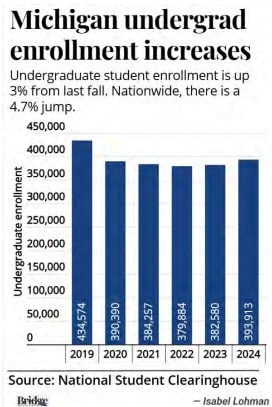
Data from the Detroit Regional Chamber shows that high school graduation rates in Michigan have increased to 85% between 2014 and 2023. College enrollment declined from 74% in 2013 to 63% in 2022, but has been seeing an increase more recently after a major dip during the COVID pandemic.
While enrollment is critical, completion is just as important to creating the necessary workforce. Graduation rate for enrollees in four-year programs (within six years of enrollment) increased from 69% in 2013 to 72% in 2017 while graduation rates for two-year enrollees stayed at 32%. This shows that the average rate of completion for two and four-year college in Michigan was 47% in 2023, an increase from 2013 when it was 40%.
These figures do not include the increase in completions for short-term credentials and apprenticeships, which are increasingly more flexible alternatives to full-time postsecondary education and critical to developing in-demand skills to meet current and future career opportunities. Community colleges are particularly important for providing certificates and industry focused short term training. Labor organizations are leaders in “earn as you learn” models like apprenticeships where they work closely with employers to provide workers while they are in training and also after completion of the apprenticeships.
What is Being Done to Address Enrollment?
Apart from perceptions of the cost and value of education, enrollment is also impacted by the region’s demographic reality. The aging of the population, lower birth and migration levels and decline in Michigan’s prime working age population (25-54) has reduced the number of people who would most likely consider enrolling in college. While the percentage of students graduating high school has increased in Michigan to 85% (from 80% in 2024), the number of high school graduates who go on to college within a year is just 63% – down from 74% in 2013. These traditional undergraduate students who used to make up a majority of students, are declining as a group. Nontraditional students including those above the age of 25, those who are working full time, and those with families are increasing in numbers. As a result, the strategies for increasing enrollment and completion results for a diverse student body need to reflect the specific needs of each group.
Providing support or wraparound services such as transportation and childcare assistance, as well as mentoring and navigation services, and easy access to information and career pathways may lead to increased enrollment and completion.
Oakland80 is an initiative of Oakland County government “designed to assist residents in securing a degree or credential beyond high school” with a goal of ensuring that 80% of county adults have a post-secondary degree or credential by the year 2030.
“Our Oakland80 initiative is helping empower people to overcome the barriers that are holding them back from getting the education and training they need to kickstart or change their jobs,” says Oakland County Executive Dave Coulter. “We know that college degrees and advanced training lead to more fulfilling careers and higher wages. That’s priceless for our residents and an added incentive for employers to move to or expand in Oakland County in order to tap that pipeline of talented workers.”
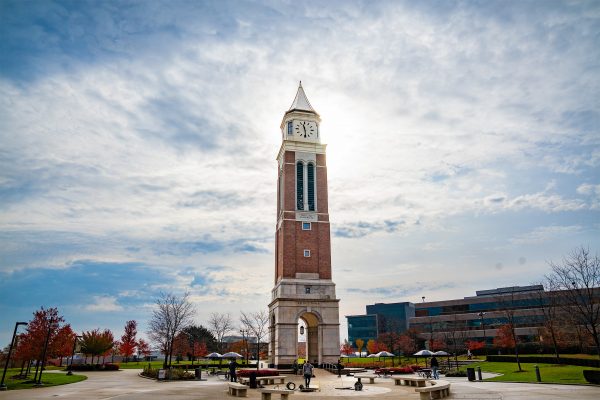
Elliott Tower, Oakland University
Increasing Enrollment
- Expose students to careers requiring postsecondary education through hands-on experiences like MiCareer Quest, Manufacturing Day.
- Educate students and their parents about the application process and financial resources available to help cover the costs.
- Raise awareness of career pathways through college, certificate, and apprenticeship programs through a more robust and inclusive career counseling and navigation system that matches students interests with high-demand careers.
Increasing Completion
- Provide students with academic and personal supports and wraparound services.
- Create opportunities for flexible scheduling to meet needs of students.
- Expand internships, apprenticeships, and paid training programs.
SEMCOG, along with the Metropolitan Affairs Coalition is working with partners in education, workforce development, and business to identify successful strategies and develop a campaign to increase both enrollment and completion. Look out for more information this summer, and please contact us if you would like to be part of this effort.
One response to “The Value of Postsecondary Education”
Posted by Dennis
This post does an excellent job highlighting why postsecondary education remains such a critical investment, both for individuals and for society as a whole. I appreciate how you discuss not just job prospects and earning potential, but also the broader benefits civic engagement, personal growth, and long-term community resilience. By framing postsecondary schooling as more than a career stepping stone as a source of empowerment and social mobility your article makes a strong case for supporting access and advocating for educational policies that widen opportunity. It’s a compelling reminder that education is foundational to collective progress.
Posted on December 2, 2025 at 8:23 am