
Speculation on anticipated tariffs – particularly those on Canada and Mexico – continues to drive uncertainty around future economic conditions. While the impacts of tariffs will be felt throughout the country, Southeast Michigan is likely to experience particularly negative effects.
Michigan’s economy is heavily interdependent on trade with Canada and Mexico
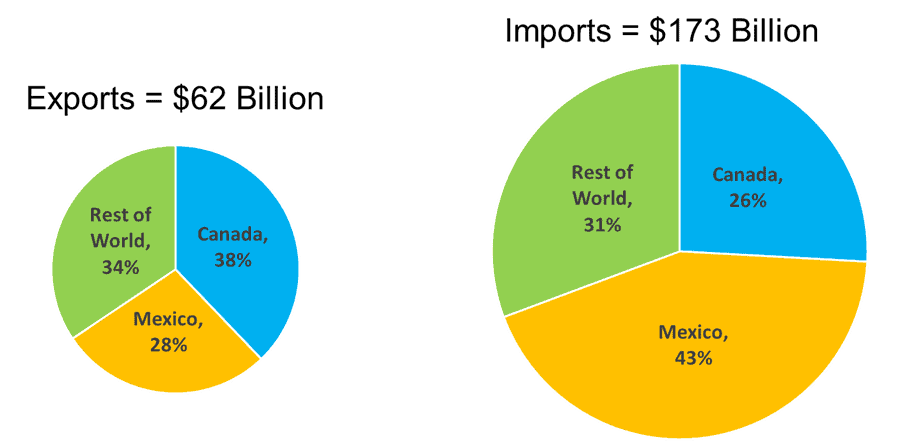
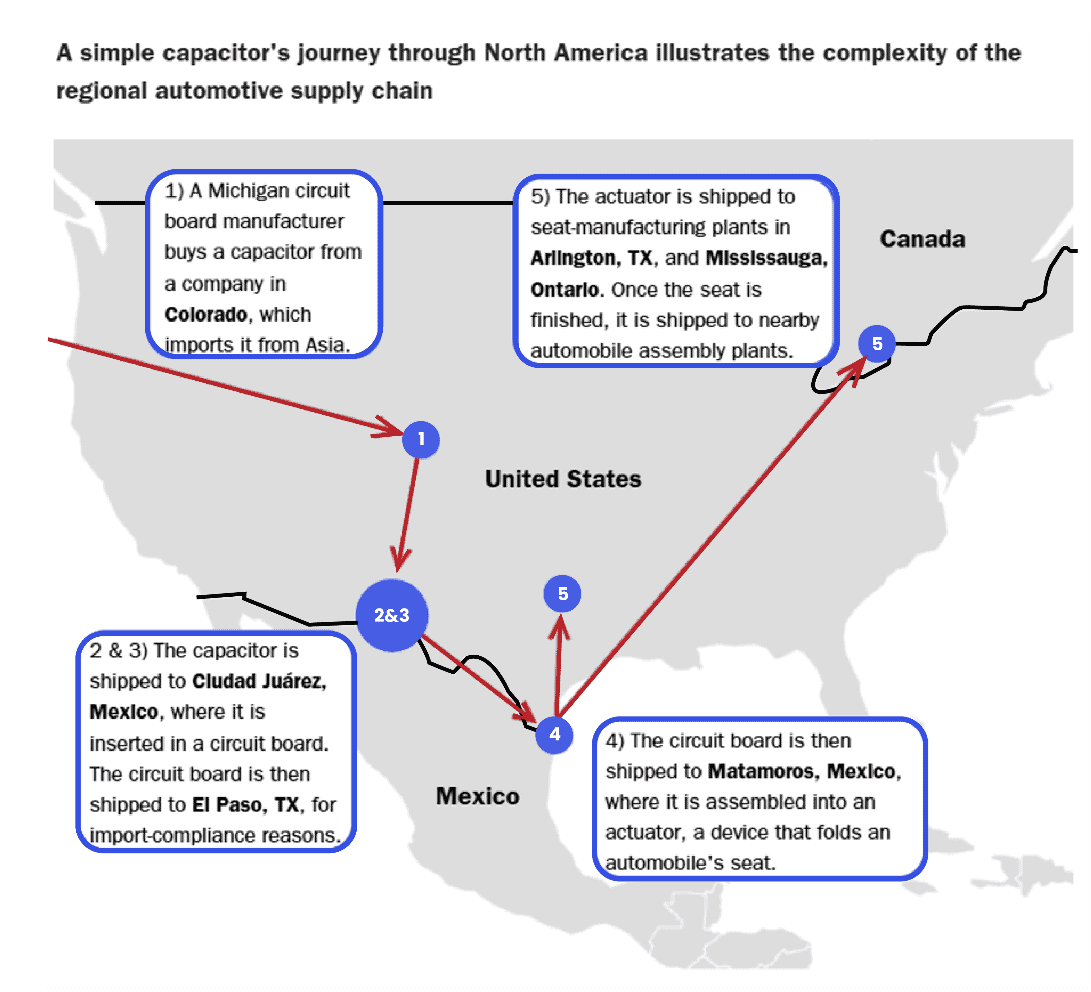
Michigan is ranked second among states in terms of imports from each country, with almost 70% of Michigan’s imports are from Canada and Mexico (Figure 1). Motor vehicle parts may cross the border of all three countries multiple times before finding their way into an assembled vehicle (Figure 2).
Figure 1
Canada and Mexico are Michigan’s Top Trade Partners, 2024
Source: SEMCOG analysis of International Trade Administration data.
Figure 2
One Automotive Part’s Journey Through the North American Supply Chain
Source: The Cato Institute adaptation from Thomas Black, Jeremy Scott Diamond and Dave Merrill, “One Tiny Widget’s Dizzying Journey Through the US, Mexico and Canada,” Bloomberg, updated May 31, 2019.
What is a Tariff?
A tariff is a tax or duty imposed by a government on imported or exported goods. It is used to regulate trade, protect specific domestic industries, protect industries contributing to national security, or generate revenue.
Who Pays the Tariff?
Importers: The tariff is paid by the company or individual importing the goods into the country. This cost is usually added at customs before the goods can enter the market.
Consumers: Although the importer directly pays the tariff, they often pass the extra cost onto consumers by increasing the price of goods.
Will tariffs bring back jobs in the long run?
An argument for tariffs is that short-term pains will be justified by the restoration of jobs in the domestic manufacturing sector. One challenge is that our region and country currently face a labor shortage, which could make workers for those jobs hard to find.
Most jobs that have gone overseas are labor intensive and pay lower wages. If companies reshore these jobs, wages will need to be higher to entice workers. This will result in higher prices and fewer goods sold. This will make it difficult to get all those jobs back.
Manufacturing is going through rapid disruption, and re-skilling is essential. The jobs of the future look different than those of the past. Future production jobs are likely to be augmented with AI, robotics, and 3-D printing. Future workers will need these newer skills to produce, which will require training and experience.
If we want to bring these jobs back, there needs to be a comprehensive strategy. Tariffs should play only a very small role in this strategy (if any role at all).
What the Data Says: Broad-based tariffs only damage the Southeast Michigan and U.S. economies
A recent study found that U.S. tariffs enacted in 2018-19 caused a decline in manufacturing employment (largely due to higher input prices and retaliatory tariffs). Many counties with an existing manufacturing base failed to thrive.
The Tax Foundation and The Budget Lab at Yale predict the tariffs imposed in March 2025 will lead to lower potential GDP by 0.1% to 0.4% over the next 10 years, and the Tax Foundation predicts the tariffs imposed in March 2025 will lead to 300,000 fewer jobs over the next 10 years.
The Impacts of Retaliation
If Canada or Mexico chooses to retaliate against our country’s automotive sector, Southeast Michigan’s impacts include:
- Of Michigan’s $62 Billion in exports, roughly two-thirds are linked to the automotive sector.
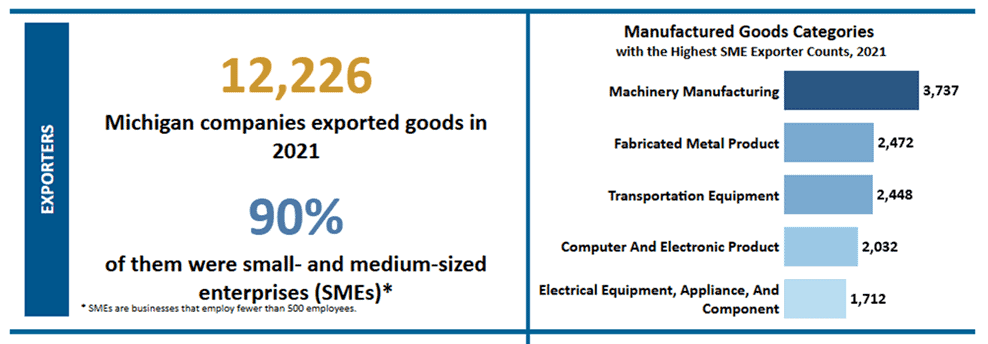
- Of the 12,000+ Michigan companies that export goods, 90% of them are small- and medium-sized businesses (with fewer than 500 employees) (Figure 3).
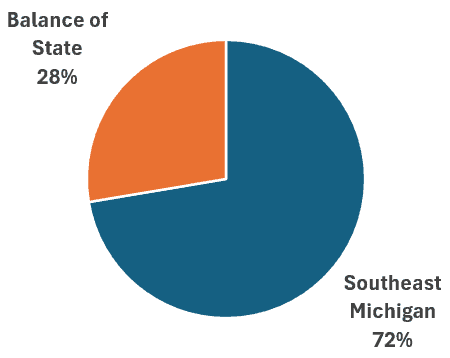
- Of all Michigan’s exports, 72% are linked to companies in Southeast Michigan (Figure 4).
Figure 3
Michigan’s Exporters are Mostly Small to Medium-Sized Businesses
Source: International Trade Administration.
Figure 4
Southeast Michigan’s Share of State Exports, 2023
Source: International Trade Administration; analysis by SEMCOG.
Local governments feel the costs of tariffs
In an environment influenced by these new tariffs, local governments will face challenges related to reduced economic development investment. Higher costs on infrastructure and capital improvements will also be felt by local governments and constituents.
Even as a threat, tariffs diminish long-term economic growth, relationships, and opportunity
Apart from their impact if implemented, the effect of merely threatening tariffs comes with its own costs. Primarily, the threat creates uncertainty in the business cycle. With more questions than answers (What countries? What products? How long? How much? Etc.), decision-makers are likely to be more deliberate with their investment choices.
This type of uncertainty is particularly volatile for an automotive industry that’s stressed with global competitiveness and changing technology while trying to keep vehicles affordable.
Tariffs may also damage relationships with our Canadian neighbors, which will be particularly felt in Southeast Michigan. People throughout Southeast Michigan maintain essential relationships with Canadian family and friends.
The Gordie Howe International Bridge – an immensely important infrastructure project that includes the region’s first non-motorized access point to Canada – will connect trail systems in both countries. The economic benefits of tourism and quality-of-life benefits are all subject to impact in a chillier relationship with Canada.
Finally, Canadian residents commute to work at Southeast Michigan firms each day. These workers are essential to filling jobs in healthcare, professional and technical services, and manufacturing.
The desire to bring back good-paying, manufacturing jobs is an admirable goal; for it is one that SEMCOG is pursuing through its Economic Development Strategy. If we are to protect existing jobs and even bring jobs back that have been lost, there needs to be a comprehensive reshoring strategy. Tariffs should play only a very small role in this strategy, if any role at all.
Leave a Reply