
When I first started at SEMCOG in 2008 [hard to believe it’s been that long already!], the 2008 Financial Crisis was literally months away. In the months after, local government property tax revenues – the largest source of revenue for local governments – were in freefall due to the collapse of the Housing Market. As a then-recent college graduate studying for my Master’s in Public Administration, it was an unsettling time to start a career in the public sector.
During the Great Recession, SEMCOG engaged with our members to share best practices and offer hands-on analysis on how to reduce costs without significantly impacting services. Collaboration and contracting to provide services were often “low-hanging fruit” and, while it felt scarier at the time, in hindsight it was truly a fascinating time to work with local leaders. As communities banded together to maintain public safety, parks and recreation programming, clear snow, and cut grass – one thing was clear: Elected officials across the region were willing to think outside the box to “keep the lights on” so-to-speak.
More than a decade later, collaboration is still alive-and-well among local governments across the region. SEMCOG staff know this because we pick up anecdotes about these collaborative efforts when we’re out meeting with member communities or chatting at SEMCOG events. But as you know, we’re always looking for some data to back up what we’re hearing.
Surveying the Region’s Collaborators
In July, SEMCOG and our sister organization the Metropolitan Affairs Coalition kicked off a local government survey to better understand how communities are collaborating throughout the region. 32 communities responded to the survey, sharing their examples and experiences collaborating or contracting with other communities to provide services to residents.
The first series of questions in the survey focused on how communities are collaborating to provide services. As you can see in the chart below, parks and recreation and public safety are services areas that are favored for collaboration.
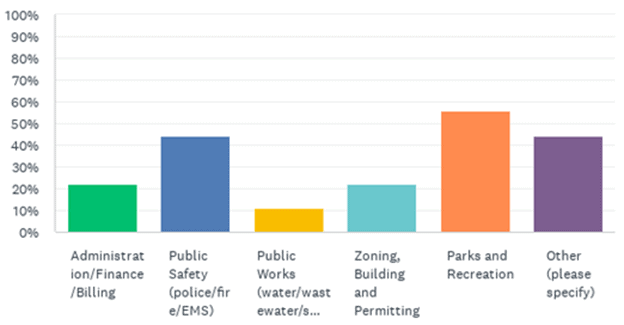
In the “other” category, examples of collaboration included operational issues, like: shared road salt storage between the local government and school district; and sanitary/wastewater agreements with The Great Lakes Water Authority (GLWA) and Detroit Water and Sewerage Department (DWSD).
When asked how these collaborative arrangements benefitted residents, local leaders said that the agreements resulted in:
- Expanded public safety service through mutual aid/authorities
- Recreation service expansion across multiple communities
- Cost savings (one-time, ongoing)
- Environmental protection
- Transparency/data gathering
- Reduced overhead/HR administration cost savings
- Rebuilt/restored playground
- Acquisition/development of new park
- Improved maintenance on trails connecting communities
The survey also asked respondents to share their contractual agreements for service delivery.
As you can see in the chart below, public safety and zoning, building, and permitting were the two most common types of contractual agreements. Public works and parks and recreation services were also common areas for contractual agreements.
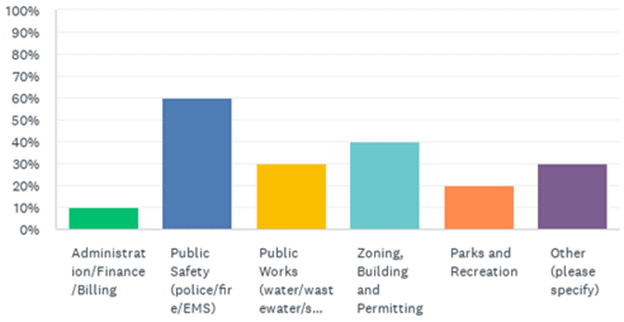
In the “other” category, examples provided fit into the response categories, but communities were engaged in multiple contractual arrangements – primarily related to public safety and zoning services.
Local leaders said that these contractual agreements resulted in:
- Increased safety, reduced response times
- Maintained services during Great Recession
- Grow social/political “good will” across municipal boundaries
- Cost savings (ongoing)
- Improved housing in community
- Avoided constructing/operating water/sewer plants
- Eased operational/staff management challenges
- Higher level of professional services provided to residents
- Coordination of services with other communities
- Sense of regional/multi-community cooperation and pride
We also asked community leaders to share the barriers they experienced throughout the collaborative or contractual processes. The most significant barriers – shown in the chart below – were: demonstrating the mid-long-term savings and Return on Investment (ROI); and the actual or perceived “loss of control” by sharing decision-making with other communities/entities.
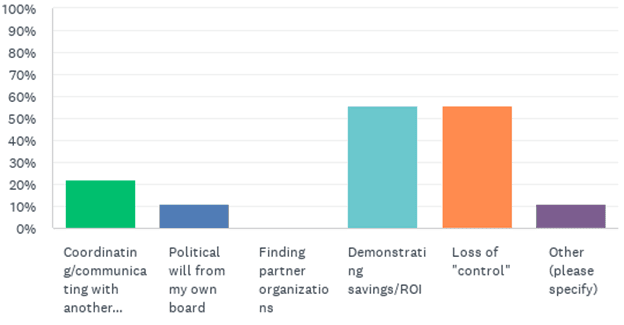
Of course, a recession like we saw more than a decade ago would certainly help overcome some of these barriers. But overall, it is great to see collaboration is still strong in Southeast Michigan. It’s always nice when the “data” backs up the “anecdotes.”
SEMCOG’s Locals Lead Initiative
The collaboration survey was administered as part of SEMCOG’s Locals Lead Initiative, which highlights the vital role that local leaders have in Southeast Michigan’s success.
Effective leaders innovate and collaborate to foster resilient, vibrant communities. They provide a calm and steady voice and help to cut through misunderstandings. They combat divisiveness and lead constructive conversations that reach mutually beneficial outcomes. Each of the presenters and projects featured in our Modernizing Municipal Buildings webinar were the embodiment of “locals leading.” I want to thank each of our presenters for leading their communities through these challenges to enhance their municipal facilities – to the benefit of their residents and community employees.
Over the next several months, we will be hosting webinars on a variety of topics that provide innovative and practical approaches for local leaders to move their communities forward. And, throughout the Locals Lead initiative, we’ll be looking for opportunities to share YOUR STORY. If you have an example of how your community is leading through innovation or collaboration, let us know! We’re eager to share your stories on social media, blogs, and through presentations at webinars and events. Please reach out if you have a story to share!
Leave a Reply