
E-bikes and e-motos are changing the way people ride around Southeast Michigan – for both transportation and recreation. SEMCOG is working with our local partners and experts in this space to educate on the basics of e-bikes and e-motos to ensure our community members know how to ride safely and responsibly.
Information is included below on e-bikes, e-motos, and the differences between them as well as resources to help in their increasing popularity on our roadways.
On September 2, 2026, SEMCOG hosted a SEMCOG University on E-Bikes, E-Motos, and other Micromobility devices with guest panelists from the League of Michigan Bicyclists (LMB), Michigan’s Office of Highway Safety Planning (OHSP), Michigan’s Department of Natural Resources (DNR) and Programs to Educate All Cyclists (PEAC). You can view the recording here.
What Is a Legal E-Bike?
The Michigan Compiled Law (MCL 257.13e) states that an electric bike (e-bike) is defined by a seat, pedals, and an electric motor of 750 watts or less. In Michigan, an e-bike is defined as a bicycle with:
- A seat or saddle
- Fully operable pedals
- An electeric motor of 750 watts or less
An e-bike can be a regular bicycle that is equipped with an integrated motor and rechargable battery. It can assist in pedaling or can propel the bike without pedaling at higher speeds than a traditional bicycle.
E-Bike vs. E-Moto: Know the Difference
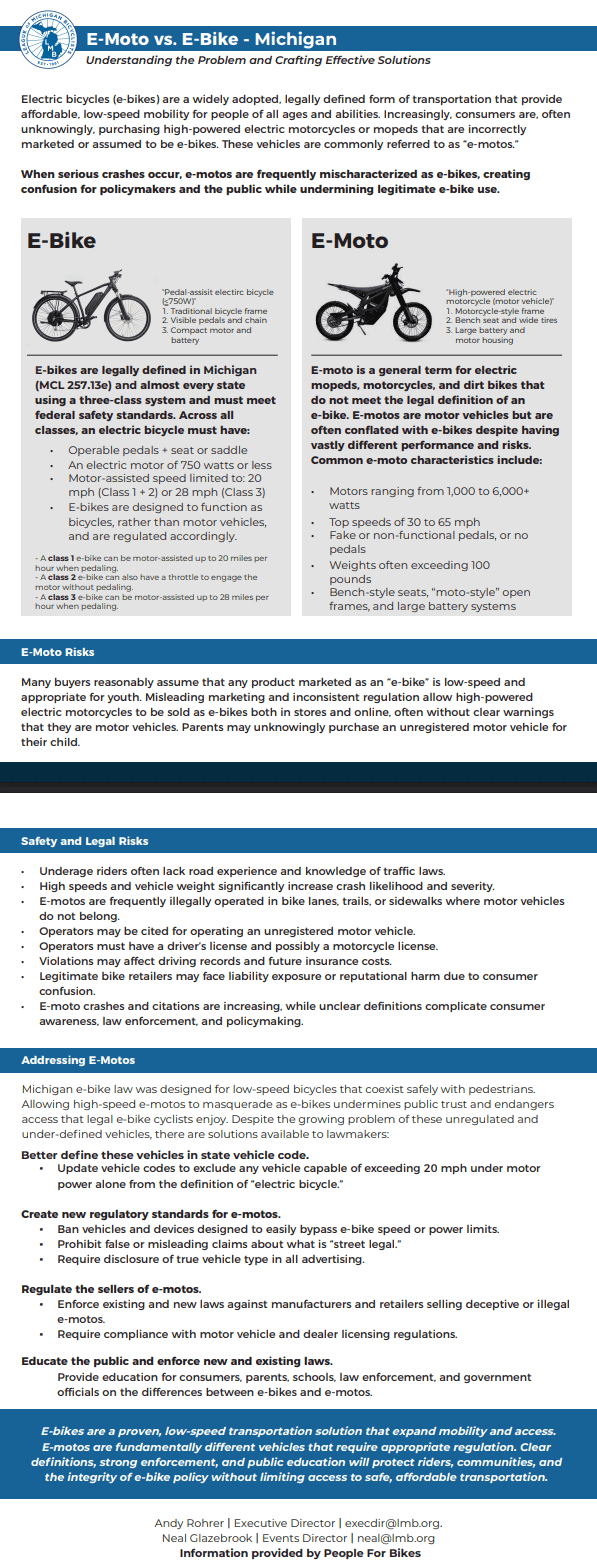
In 2017, Michigan legalized e-bikes statewide and created a three-class system that defines e-bikes and how they are regulated for riders and trail access:
- A class 1 e-bike can be motor-assisted up to 20 mph when pedaling.
- A class 2 e-bike can also have a throttle to engage the motor up to 20 mph.
- A class 3 e-bike can be motor-assisted up to 28 mph when pedaling.
All three are treated as bicycles under most state laws, but where you can ride them varies by class.
Under this law:
- Manufacturers and distributors must permanently affix labels indicating classification number, wattage, and top assisted speed
- E-bikes are treated like bicycles for most rights and duties
- Additionally, “a device shall not be considered an electric bicycle if the motor is modified” in a way that changes its original classification, or increases the motor’s wattage above 750.
Recently, there has been an increase in use of high-powered, motorcycle-like vehicles, often called “e-motos,”. These vehicles are frequently mislabeled as e-bikes and can then bypass safety regulations and equipment standards, creating confusion for consumers and safety risks for road and trail users.
Key illegal features of an e-moto:
- Motor power >750 W
- Top assisted speeds beyond class limits
- Modes that switch into high-speed “off-road” without pedaling
- Removing/detaching pedals entirely
- “Hacking” legal devices to operate illegally
Where Can You Ride an E-Bike in Michigan?
E-bikes are generally allowed anywhere traditional bicycles are permitted, including roads, bike lanes, and shoulders. No license, registration, or insurance is required under Michigan law. Sidewalk use may depend on local ordinances.
Trail access varies by e-bike class (MCL 324.72105(2) and MCL 257.657) and who manages the property, so be sure to check local rules and posted signage.
CLASS 1: Allowed on roads, bike lanes, and many paved non-motorized trails such as rail-trails. Some unpaved trails may allow Class 1 where specifically authorized.
CLASS 2 and 3: Allowed on roads and bike lanes. Access to paved trails and rail-trails depends on approval from the local authority. Always check local trail rules. One trail might allow Class 2, another might not.
OCEVs: Higher-powered electric vehicles that fall outside Michigan’s e-bike definition may require registration and street-legal equipment for road use. They are not treated the same as e-bikes.
Safety, Rules, and Etiquette
E-bikes follow the same traffic rules as traditional bicycles, including:
- Obey traffic signals
- Ride with traffic, ride predictably
- Signal turns
- Yield to pedestrians
Helmets are recommended (especially Class 3). Although helmets are not required statewide, some municipalities do require them. Check your local ordinances.
Trail / Path Etiquette
In addition to practicing courtesy, communication, and common sense, responsible e-bikes users should:
- Stay within posted speed limits (It’s easy to go too fast on an e-bike. Start out slow, know your limits and stay in control at all times.)
- Yield to pedestrians and traditional bike traffic
- Use audible signals when passing (E-bike riders should slow down and warn by bell or voice “On your left!” when passing. You’re required by MI law to yield and warn on sidewalks.)
- Slow down when passing or near other trail users (Yield to horseback riders. Stop, Speak and Stand Back when you encounter an equestrian. Stop to give the horse and rider time to pass, Speak to communicate your presence and location, and Stand Back to give the horse space — move off on the lower side if possible, and don’t hide behind a tree.)
Safety Tips
- Practice braking and throttle control – braking takes longer from higher speeds
- Understand battery discharge and range
- Be mindful of heavier weight and longer stopping distances on e-bikes
Resources and Sample Rules & Ordinances
Resources:
E-Bikes: League of Michigan Bicyclists
Michigan Trails and Greenway Alliance E-Bike Toolkit
E-motos, sometimes mistaken for e-bikes, causing trouble on Michigan trails – Bridge Michigan
AAA Launches ‘E-Ride Ready’ Campaign to Prevent E-Bike and E-Scooter Injuries
Oakland County Sheriff’s Office
Not every electric bike is legally considered an e-bike. Depending on its speed, power and design, it may be classified as an electric motorcycle, which comes with different requirements for where it can be ridden, licensing, registration and insurance.
Sample Rules & Ordinances:
South Lyon
Class I, II, & III E-bikes, electric skateboards/scooters are allowed on a linear trail that has an asphalt, crushed limestone, or similar surface.
Electric bicycles do not include e-motos
Riders shall yield to the right-of-way to pedestrians, bicycles, and other human-powered conveyances.
Huron-Clinton Metroparks
Class 1 and Class 2 e-bikes are allowed on paved hike-bike trails within the Metroparks. Class 1 e-bikes are allowed on Authority-designated mountain bike trails within the Metroparks. E-bikes must be clearly labeled with their appropriate classifications. They will be subject to the same speed limits as non-motorized bicycles and are not to exceed 10 miles per hour. E-motos do not fall under the rules for e-bikes.
Grosse Ile Township
Bicycles, Class 1 e-bikes, Class 2 e-bikes, and electric skateboards/scooters shall operate at a reasonable and safe speed on sidewalks unless posted otherwise. Operation shall be a reasonable speed for pedestrian conditions and shall not be an unreasonable speed when pedestrians are present. Operators must yield to pedestrians and give an audible signal before overtaking on the left. Class 3 electric bicycles and mopeds are prohibited on sidewalks. No person shall operate a permitted device on a sidewalk or shared-use path at a speed greater than is reasonable and proper under conditions or in excess of 15 mph unless otherwise posted. The Township prohibits the use of electric bicycles, electric skateboards/scooters, or mopeds on unpaved trails, nature areas, or environmentally sensitive locations. References OTHER POWER-DRIVEN MOBILITY DEVICES (OPDMDs) for individuals with mobility disabilities for the purpose of locomotion.
For more information or questions, please contact Brian Pawlik, SEMCOG Transportation Planner III, at [email protected]