
A recently announced partnership of the Gilbert Family Foundation (GFF), Henry Ford Health, and Shirley Ryan AbilityLab will bring a 72-bed state-of-the-art physical medicine and rehabilitation facility to Henry Ford Health’s expanding campus in Detroit (along with a neurofibromatosis research institute in memory of their son).
This project highlights the importance of quality, accessibility, and equity of healthcare services in our region. Healthcare is our region’s largest employment sector, and this will continue. When counting both private and public (public includes Michigan Medicine, the Veterans Administration hospitals, and public health departments) healthcare, Southeast Michigan has nearly 400,000 healthcare jobs. These numbers recently dipped due to COVID’s impact, but they are rising again and on track to return to 2019 levels in 2024. By 2050, our region is expected to gain almost 86,000 healthcare jobs, a gain of 22%.
But even more important than the job growth is that this new facility promotes development patterns to meet the region’s needs for services and infrastructure, one policy from SEMCOG and the Metropolitan Affairs Coalition (MAC)’s Increasing Shared Prosperity, the Comprehensive Economic Development Strategy (CEDS) for Southeast Michigan. In this case, it’s the development of healthcare infrastructure. Ensuring that all our region’s residents, no matter where they live, have access to affordable, quality healthcare is critical to our adaptation to an aging population and to the region’s shared prosperity.
Collaborating to take on Healthcare’s Biggest Challenges
MAC currently has a Healthcare Task Force looking into challenges impacting the region’s healthcare system. Two of the challenges are healthcare equity and workforce development. At its August 2023 meeting, task force members shared strategies for making the healthcare system more equitable. Suggestions include expansion of telehealth services (coupled with broadband accessibility), increasing funding and accessibility for food programs so the healthcare system is not incurring those costs, and preparing and supporting the healthcare workforce.
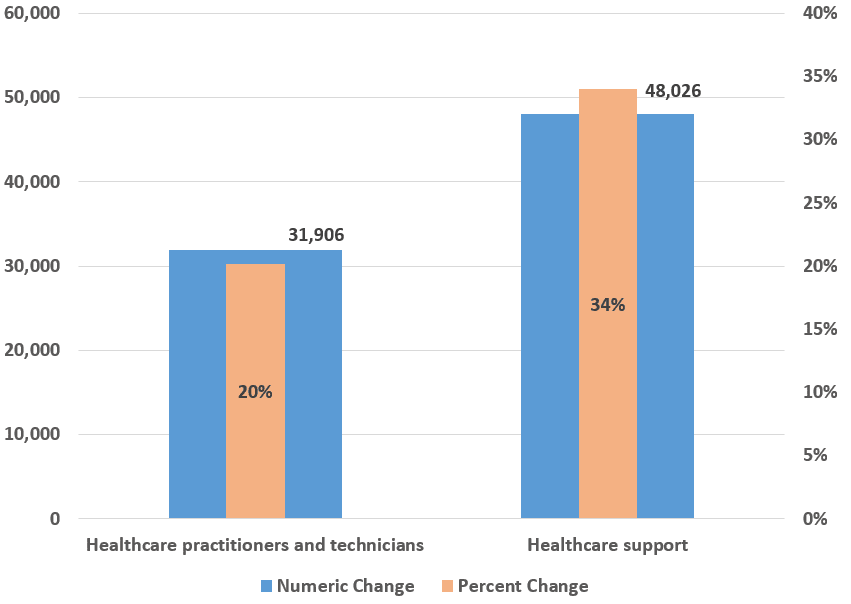
This last suggestion – preparing and supporting the healthcare workforce – will be the topic for the task force’s next meeting. SEMCOG forecasts healthcare occupations to grow at a similar rate as employment – or by almost 80,000 (or 27%) over the next 30 years. Most of these occupations will be in healthcare support, which is forecasted to grow by 48,000 occupations, or 34% (figure 1). People working in healthcare support occupations, as the name implies, assist healthcare practitioners and technicians in delivering services to patients. Some examples include home health and personal care aides, medical assistants, and nursing assistants. These occupations generally require less than one year of education and training.
Figure 1 – Healthcare Occupation Forecast, 2019-2050
Source: SEMCOG 2050 Forecast
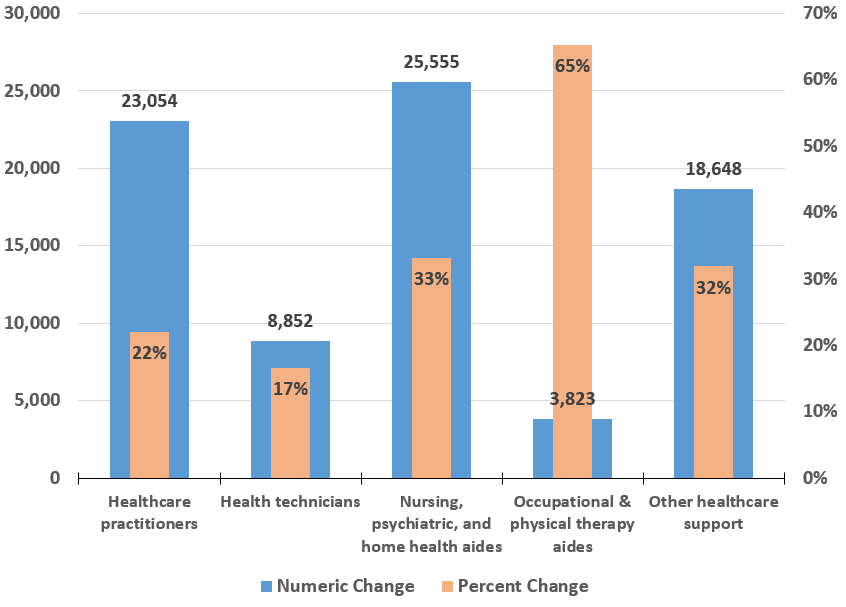
Figure 2 breaks down the categories shown in Figure 1 in more detail. Healthcare practitioners and technicians will grow at similar rates of 22% and 17%, respectively.
Healthcare support occupations grow faster with nursing, psychiatric, and home health aides growing by 25,000 or 33%; occupational and physical therapy aides growing by almost 4,000 or 65%; and other healthcare support occupations growing by 18,000 or 32%.
Figure 2 – Detailed Healthcare Occupation Forecast, 2019-2050
Source: SEMCOG 2050 Forecast
Getting the workforce ready to meet this demand will be a challenge. Despite the demand for healthcare workers, a recent Pulse of the Region survey found that 70% of respondents are not interested in healthcare careers. Respondents cite reasons such as inadequate pay; cost and time for training; too much burnout; and long hours. Indeed, according to the Bureau of Labor Statistics, median the hourly wage for healthcare support occupations is $16 per hour in the Detroit-Warren-Dearborn metro area. This translates into a median annual wage of $33,550 for full-time workers.
What can be done? How can more support workers be brought into the healthcare field? Perhaps there can be other forms of compensation like tuition reimbursement, access to care for their own children or dependents, or health and wellness initiatives to address burnout. These are just a few of my own ideas.
More will be discussed at the next SEMCOG/MAC Healthcare Workforce Symposium on November 1, 2023. Please register if you would like to attend.
Leave a Reply