
A version of this article was originally featured in SEMCOG’s Economic Development special edition magazine: What’s Our Edge?. Let us know if you would like to request hard copies. Southeast Michigan’s success depends on the unique strengths of its communities, businesses, and educational institutions. Regional cooperation, data-driven strategies, and a skilled workforce are key to driving growth. The Gordie Howe International Bridge, access to water, and education play vital roles in shaping the region’s future. By aligning these assets, the region can achieve greater prosperity, guided by the Economic Development Council’s new strategy.
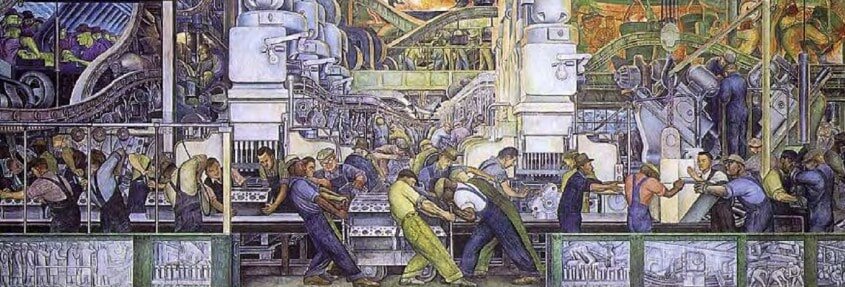
Detroit Industry Murals by Diego Rivera – Detroit Institute of the Arts
Southeast Michigan is undergoing a renaissance in innovation thanks to broad collaborative efforts across the region. These include the three research universities and other institutions of higher education; new anchors such as Michigan Central; county and city leadership; corporations who are investing in innovative strategies to improve products, services, and outcomes; funders who are investing in creative people and products; and individual founders who are shaping the future with applications, manufacturing, and support for the new generation of innovators. Together they are creating a new innovation ecosystem that builds on Southeast Michigan’s many natural, institutional, and cultural assets to reposition the region as the center of innovation.
Southeast Michigan has been known for its industrial strength for more than a century, but the national and global economy is increasingly dominated by technology-based growth, and other regions have supplanted Michigan’s economic dominance. For Michigan to retain its economic influence, it needs to leverage its considerable assets to build an innovation ecosystem.
A recent study by the Creative Class Group makes the case for a Detroit-to-Ann Arbor Innovation Corridor. The report specifically calls out two main strategies for the region. These are “deepening” – applying new technologies to improve existing industries, and “shifting” – applying new technologies to generate new industries. The Detroit Regional Chamber’s 2025 Detroit Policy Conference – “Driving the Innovation Economy” – outlined efforts at how the region is both shifting and deepening.
Collaboration is a central theme of innovation. Apart from active cross-sector partnerships, a successful innovation ecosystem needs investors, facilities, and an environment that responds to the needs of small businesses and a strong quality of life. There is a strong focus on access and providing opportunities to all stakeholders. Providing forums that are open to all stakeholders ensures that the innovation ecosystem is more than a sum of its parts.
Michigan Central has become a catalyst for the region’s Innovation Ecosystem. Even before its official opening in June 2024, it had created excitement as an open platform where founders could thrive. There are 135 startups currently working on projects including Electrification; Applied AI; Advanced air mobility ; Climate and clean technology; Alternative energy and batteries; and Material sciences and life sciences.
Mary Culler, President of Ford Philanthropy and Chair of Michigan Central calls it a center for “creative collisions, accidental collaboration, the more people who come in the better.” The most important factors for success are sense of community, access to capital, and more tools for early stage companies such as wet labs. Michigan Central’s focus is not only on the work but who is doing it. Josh Sirefman, Chief Executive Officer of Michigan Central, sees Michigan Central as emerging into a new competitive advantage for Detroit and the state. He says, “The region must lose the scarcity mindset and develop a strategy to collectively maximize the opportunities through a clear inclusive vision and collaboration.” Some of the education, business and government leaders helped to create the innovation ecosystem and joined together to sign the Research and Development Tax Credit legislation.

Education, business, and government leaders signing the Research and Development Tax Credit legislation at New Lab at Michigan Central on January 13, 2025
How Businesses and Founders are Creating the Innovation Ecosystem
Innovation can take place at both small and large companies. As a leading healthcare nonprofit, Blue Cross Blue Shield of Michigan sees innovation as a way of achieving better health outcomes and affordability in an environment of increasing costs. It is using technology and AI to speed up care in the Emergency Room, improving access to data and information at its call centers, collaborating with valued partners on data sharing, and using a concierge program to reach out to members to support preventive care.
Michael Healander is the President and CEO of Airspace Link – a Michigan-based start up established in 2019 that has built an air traffic control system that will safely integrate drones into national air space and communities. It is “a Google maps for drones” – digital infrastructure for 400 feet and below. Since the company was established in 2019, it has attracted $37 million from investors including the MEDC and the City of Detroit and recently expanded its footprint by moving to New Lab at Michigan Central. It works with 6,000 businesses that use drones including the Department of Defense, and is connected to 740 airports. The company is also growing in the area of advanced air mobility.

Alexa and Johnnie Turnage at the Detroit Policy Conference | January 23, 2025 Photo credit: PBS Detroit
Alexa and Johnnie Turnage are developing human capital for the innovation ecosystem in the region. They are the founders of Black Tech Saturdays. This is a two-year-old start-up focused on “fostering people to be the best version of themselves.” It empowers black professionals and entrepreneurs in tech through skill development and community engagement. It provides access, opportunities, mentorship, training, and alternate pathways. Johnnie Turnage says: “Mass tech adoption is key to economic mobility…we must expose [young people to it] and make AI mainstream.”
How Government is Supporting the Innovation Ecosystem
State and local governments have important roles in economic development. Counties in particular help improve quality of life in the communities they serve as well as supporting innovative approaches to both government services and business support.
Wayne County Executive Warren Evans believes that collaboration is critical to creating strong communities and quality of life for the county’s 1.8 million residents in 43 communities. Through focus and practical budgeting, the county achieved an AA bond rating, created a $350 million rainy day fund, and recently helped eliminate medical debt for 42,000 county residents. He is particularly proud of the award-winning, world-class Metro Airport. He sees its success depending on training the future workforce for airport-related careers. This includes pilot training, flight mechanic training, as well as other related careers. He is working with partners to create programs at City Airport. He is also focused on improving attendance and education attainment in the county with a view to creating the future workforce.
For Oakland County Executive Dave Coulter, supporting the business community is a priority. 40% of research and development in the state of Michigan is located in Oakland County. He sees the new Research and Development Tax Credit laws as expanding this further. He also expanded services to small businesses by creating Oakland Thrive. This provides consultants to work across the county to provide business services including social media, financial planning. They have connected to more than 7,600 small businesses. The Project DIAMOnD (Distributed, Independent, Agile Manufacturing On Demand) initiative is fostering a county-led culture of innovation. It is accelerating the digital transformation of manufacturing by distributing state-of-the-art 3D printers to manufacturers across the county. Oakland County has a wait list of 100 companies interested in training for 3D printers. More recently, Wayne and Macomb Counties have joined this initiative to create an even larger footprint. Oakland County is also investing heavily in workforce development through the Oakland 80 initiative, increasing housing choice and expanding transit services and routes particularly to jobs centers and northern communities.
Macomb County Executive Mark Hackel has focused on physical infrastructure to improve both quality of life for residents and efficiency for business through a connected roadway system with more than 700 traffic signals and 350-plus cameras on 1,700 miles of road. This has built on the county and region’s strength as the arsenal of democracy by innovatively growing the manufacturing industry through defense and next generation nuclear submarines as well as traditional auto related manufacturing. The county is fueling the talent pipeline through strong partnerships between businesses, the county’s Planning and Economic Development department, local school districts, Macomb Intermediate School district and Macomb Community College. The county is also improving health care by creatively embracing mental health through communitybased support within public safety.
How Education is Leading the Innovation Ecosystem
All three of Michigan’s research universities have a pivotal role in the innovation ecosystem. Wayne State University has a strong history in medical and healthcare research. TechTown serves as Wayne State University’s economic development arm of the university to catalyze innovation with the goal of leveraging assets and to share benefits across the community. According to President Kimberly Espy, Wayne State imparts the “grit, resilience, and perseverance needed to succeed to the next level.”
President Santa Ono from the University of Michigan in Ann Arbor (at time of magazine publication) sees great opportunities in expanding the university’s presence from Ann Arbor to Detroit through the University of Michigan Innovation center in Detroit. It has a strong history of commercializing research into successful companies. There are 46 unicorns (billion dollar companies) that started at the University of Michigan. President Ono says “the stars are aligning for an amazing renaissance in Detroit.”
Michigan State University is doing groundbreaking research in a number of technology-based fields at the East Lansing Campus. It is also working in Southeast Michigan through two medical programs. The first is a partnership with Henry Ford Health System for the Future of Health project in the New Center area and the MSU Research Foundation is working on commercializing research in wellness.
To support the innovation ecosystem, the research universities are focusing on specific sector strategies, research and development, strengthening partnerships, engaging with founders early, and building the types of labs where research can be most effective.
So what will it take to build an inclusive, dynamic and sustainable innovation ecosystem in Southeast Michigan that is a national model for both “shifting” and “deepening?” Building on assets including high quality of life; geographic location and International access to Canadian markets and also Asia through non-stop flights from Metro Airport; engineering talent; comparatively lower cost of living; quality of higher education; and growing technology based enterprises. In addition, the energy around the region is attracting more investments in startups so companies can start, grow and thrive in Southeast Michigan without having to leave the state. This will lead to greater economic growth, opportunities and financial resources for individuals, businesses, and the region.
Leave a Reply