
Senator Gary Peters recently hosted U.S. Census Bureau Director Robert Santos at a community outreach meeting in Detroit. Amy O’Leary, SEMCOG Executive Director, and I attended the meeting. We discussed the importance of census products, lessons learned from the 2020 Census, and how communities and regional agencies like SEMCOG can help improve census data.
Census data are foundational to local and regional planning. As always, we urge Congress to adequately fund U.S. Census Bureau’s operations. This is to ensure that resources are available for the Bureau’s essential projects, including but not limited to the decennial Census, American Community Survey (ACS), and post-pandemic household and business pulse surveys to provide necessary detailed data on demographics, economics, and governments.
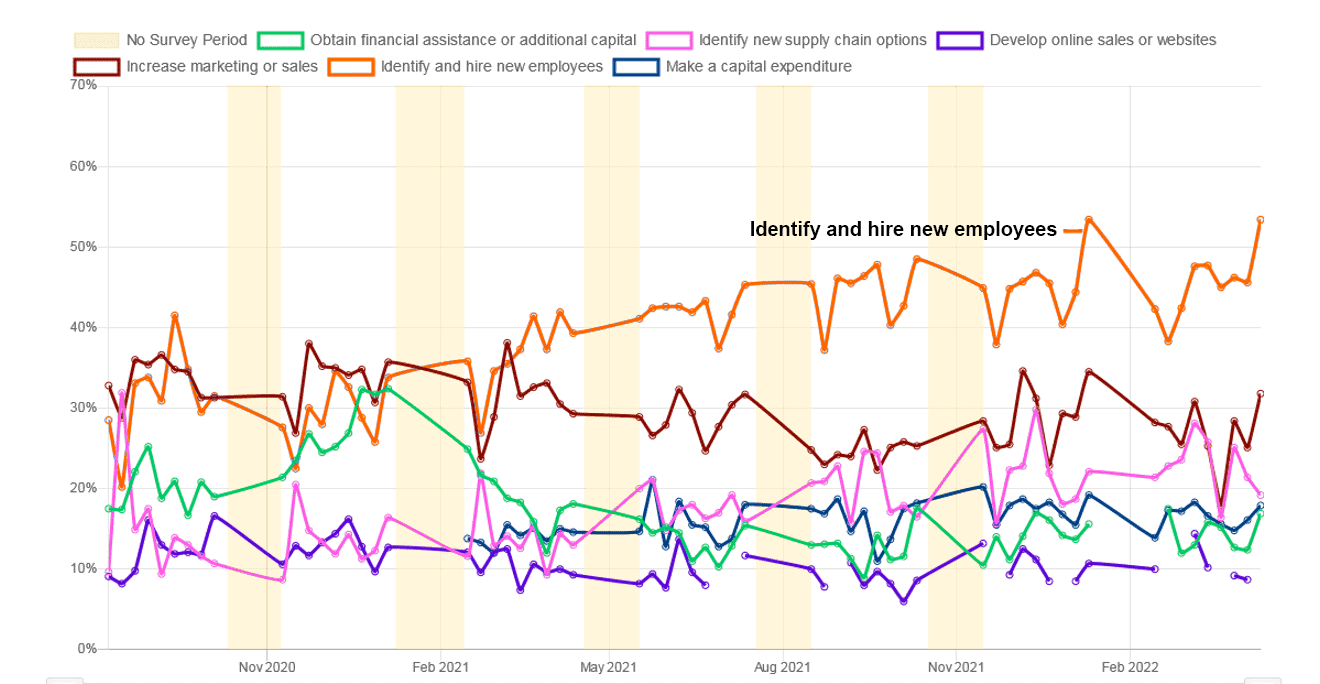
For example, the figure below highlights one of the charts in SEMCOG’s High-Frequency Socio-Economic Dashboard based on the Small Business Pulse Survey that the Census Bureau implemented during the COVID-19 pandemic. It clearly confirms what many of us have seen with our own eyes: small businesses in our region have a significantly increased need for identifying and hiring new employees. We urge Census Bureau to continue such surveys post-pandemic.
Census Survey Confirms Labor Force Need
An Inclusive Census
It is imperative for Census Bureau to improve operations and measurements of diversity, equity, and inclusion. It’s always important to have adequate resources allocated to measure hard-to-count populations to ensure data accuracy in areas with high concentrations of such populations and to improve population estimation methods for these areas and all communities. We support adding the Middle Eastern population as a new race/ethnic group in census products. We have the highest concentration of this population in our region. The current race/ethnic classification does not adequately reflect the diversity in our region.
We have concerns about the accuracy of the 2020 Census data. Based on the released data, we’ve found hundreds of census blocks with a household population but no housing units. More than half of census tracts’ total population doesn’t match the sum of the population of the blocks nested within those tracts. We believe this is caused by a new method implemented by the Bureau called “Differential Privacy,” which adds noise to data in an effort to protect privacy. We told Director Santos that these adverse effects of Differential Privacy on data quality must be carefully reviewed, evaluated, and mitigated to make the data usable.
Hoping to Continue Our Partnership with U.S. Census Bureau
Another source of error is likely in the Bureau’s Master Address File (MAF), which is the foundation for many census products. Think of the MAF as your organization’s master mailing list. Any omissions or duplications in the file would cause problems every time you use the file. We believe communities and SEMCOG can help the Bureau to make the MAF more accurate for Southeast Michigan. We have a detailed buildings database and collect new building permits and demolition data with addresses every month to update our database. Besides asking communities to provide building information once a decade before each decennial census, the Bureau may also collaborate with regional agencies like us to continuously update the MAF for better accuracy.
We thank Senator Peters for organizing this timely event and Director Santo for reaching out to communities. We appreciate the tremendous efforts by Census Bureau to complete Census 2020 under extraordinary circumstances. We look forward to opportunities for collaboration in the future.
Leave a Reply