
Building a House; Making a Home
Access to quality affordable housing has become an ongoing problem across the region, state, and country. Ever since the COVID-19 Pandemic, the cost of new housing has sharply risen. The median sales price for a new home has risen nearly 30% since mid-2020, from $317,100 to $410,700 as of mid-2026. The sharpest increase was from June 2020 to December 2021, where prices jumped 23.4% in 18 months. While prices have stabilized and are gradually falling from their peak at the end of 2022, this represents the single largest price increase since the Federal Reserve Bank of St. Louis began recording the data in 1963.
In Michigan, the median listing price is closely tied to the time of year. However, the listing prices provided by the St. Louis Fed show that prices have steadily risen since they began collecting the data in July 2016. Since then, median listing prices have nearly doubled from approximately $166,000 to $300,000 as of September 2026. Even after adjusting for inflation, the median listing from ten years ago is approximately $231,000, representing a 23% increase.
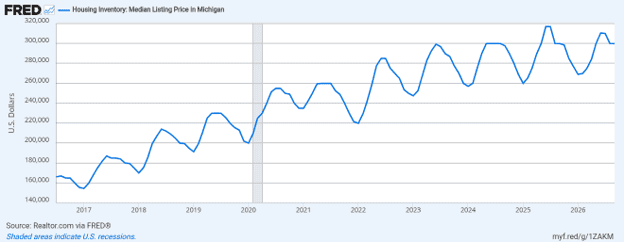
Source: Federal Reserve Bank of St. Louis, 2026
Rentals have similarly increased year-over-year, while household incomes struggle to keep up. According to September 2026 rental data from Apartments.com, Michigan is the 16th most expensive state to rent, with average monthly rents ranging from $1,076 for studios to $1,930 for three-bedroom apartments. Moreover, seven of the ten most expensive cities to rent statewide are within Southeast Michigan: Ann Arbor, Rochester Hills, Troy, Dearborn, Farmington Hills, Livonia, and Southfield. The Bureau of Labor Statistics (BLS) observed that, since March 2020, the Consumer Price Index for rentals in the Detroit-Warren-Dearborn area has risen by over 25%. This represents the single largest year-over-year increase since 1914, according to the Federal Reserve of St. Louis.
SEMCOG has been working closely with its members and fellow organizations across Michigan and the Great Lakes to identify these issues and help local governments and organizations find the right solutions, including the funding to make them feasible. SEMCOG continues to do this by building closer relationships with State and federal organizations, bringing rural, suburban, and urban communities together to collaborate, and platforming the programs and best practices to make meaningful changes to finance, build, and occupy homes for all walks of life.
Legislation and Programs
Widespread coverage of issues in the supply and affordability of housing has motivated every level of government and industry to act to expand both as soon as possible. This effort has most recently culminated in the passage of the bipartisan 21st Century ROAD to Housing Act, which became law on July 11, 2026. Among its many policies include eliminating regulatory barriers through permitting streamlining and preapproved designs, revamping U.S. Department of Housing Development (HUD) funding and review programs, and expanding the flexibility of lenders, with a particular focus on rural and community banks.
State legislators also sought to address these issues through the Housing Readiness initiative. This began with an amendment to the Michigan Planning Enabling Act in 2024, which now requires that community master plan’s include “[a]n assessment of the community’s existing and forecasted and housing demands, with strategies and policies for addressing those demands” (MCL 125.3833(2)(e)). To help communities comply with this prevision, the Michigan State Housing Development Authority (MSHDA) launched the Housing Readiness Incentive Grant to fund master plan and zoning ordinance updates. A full list of awarded communities may be found on MSHDA’s website.
Following this, the Michigan House of Representatives has taken the step to codify many of these zoning changes at the State level, introducing a slate of bills under the Housing Readiness Package, specifically House Bills 5529 – 5532 and 5581 – 5585. These bills would preempt many aspects of local zoning authority, including the building and lot size requirements for homes, timing for plan review, protest petitions, setbacks, and regulations for specific dwelling units like duplexes, manufactured homes, and Accessory Dwelling Units. SEMCOG and peer organizations like the Michigan Municipal League (MML), Michigan Townships Association, and Michigan Association of Counties, have issued statements in opposition of these bills.
While these bills are well-intentioned to more quickly close the housing gap, they risk disrupting existing housing initiatives if passed as-is, such as requiring additional amendments to zoning ordinances and master plans, delaying potentially noncompliant developments currently in the review phase, and affecting the costs and complexities of planned and ongoing capital improvements. As of writing, these bills remain in the House Government Operations Committee, and it is not known what the House may decide upon or change leading into the 2026 Midterm Elections and following lame duck months.
SEMCOG held a press conference on February 25, 2026 to provide information and address concerns regarding the Housing Readiness Package. In addition, at the Legislative Roundtable, SEMCOG collected input from local government elected officials and shared additional information on the legislation, resources available from SEMCOG and its local government partners, and upcoming events.
SEMCOG has been working with a statewide coalition to advance a bipartisan alternative: the MI Home Program, which offers a solution grounded in partnership rather than preemption. The program would provide funding to build and redevelop housing, offer incentives for communities to pursue zoning reform, create a state match for employer contributions to workforce housing, and establish a revolving loan fund designed for long-term impact with an initial startup investment. Homes supported through the program would be available at up to 120% of Area Median Income, helping to ensure affordability for Michigan residents.
SEMCOG also hosted the three-part SEMCOG University Housing Series, beginning with an in-person workshop on June 16, 2026, showcasing local success stories and programs to close housing deficits, followed by two webinars on July 20 and August 16 that discussed housing financing and housing for everyone, respectively. More information on the Housing Series may be found in Part 2 of this blog article.
Available Resources HUD: 21st Century ROAD to Housing
Alongside the planning pilot program created under the 21st Century ROAD to Housing Act, other programs include:
- Innovation Fund: $200 million annually from 2027 through 2031 to fund initiatives for expanding the attainable housing supply, install public works facilities, provide housing services, energy use strategies, and public transportation projects.
- Revitalizing Empty Structures into Desirable Environments (RESIDE) Act: $1 – $10 million per awardee annually for redeveloping commercial and industrial buildings into housing, prioritizing economically destressed areas and Opportunity Zones.
- Reforming Disaster Recovery Act: Authorizes the Community Development Block Grant-Disaster Recovery (CDBG-DR) for three more years to rebuild housing in disaster-impacted areas.
As of September 2026, Congress has not yet authorized the funding for these grant programs. However, HUD has by July 11, 2027, to establish these programs.
MSHDA: Statewide Housing Plan and MI Neighborhood
MSHDA has been actively involved in addressing the statewide housing crisis since adopting the first Statewide Housing Plan (“SHP 1.0”) in 2022. SHP 1.0 approaches housing from a regional lens, building coalitions through Regional Housing Partnerships that collaborate between local governments, organizations, businesses, and residents to provide a plan that best reflects the character and condition of those areas. The Housing Partnerships Map shows who these representatives are in the region, as well as the organizations in charge of each RHP.
SHP 1.0’s original target for 2022 was to provide at least 75,000 new or rehabilitated housing units by 2027. That threshold was crossed in late 2025, and so MSHDA increased the goal to 115,000. As of June 2026, that goal is 84% complete. SHP 2.0 is still in development, with MSHDA preparing its research and data analysis following the Spring-Summer 2026 community engagement period. By mid-2027, the State will look to adopt the final plan. Active engagement in the plan’s development is important across all sectors, as a successful plan must be a product of the input and priorities of the community it serves.

MSHDA has also been invested in having ground truth for housing issues and so has worked closely with MML and the Michigan Association of Planning to develop the Michigan Housing Data Portal. The Portal breaks down information on demographics and housing supply and affordability from the state level to individual communities. For county and local governments in particular, this tool can help assess housing stock and conditions while preparing a master plan or housing study.
For funding, MSHDA’s main vehicle is the MI Neighborhood Program, which provides funding for nonprofits, local unit of governments, and for-profit developers to build and rehabilitate housing. The first window for MI Neighborhood 4.0 launched on October 1, 2026, and closed on October 14. Additional windows may open on January 4 and March 8, 2027, if funds are available. The link above provides overview documentation and educational resources about MIN 4.0, as well as a link to start an application and contact MSHDA staff for support. CDBG Entitlement communities are not eligible for MI Neighborhood funding, as the program uses a combination of unentitled CDBG and Housing and Community Development Fund (HCDF) dollars to fund projects
Local Public, Nonprofit, and Private Sources
There is no shortage of options for financing development from local and nongovernmental organizations. For example, the Oakland Together Housing Trust Fund (HTF), based out of Oakland County Neighborhood & Housing Development, funds projects of various types throughout the county, including new construction and rehabilitation, as well as related activities such as acquisition, demolition, supportive housing, and infrastructure improvements.
Another impactful option is financing through a community development financial institution (CDFI), which are nonprofit banks that specialize in lending toward projects focused on affordable and attainable housing. LISC Detroit and Cinnaire are two such institutions that have worked across the region to close financing gaps and make affordable housing more feasible.
There are many different resources on this front that are available, and will be covered more in depth in Part 2 of this blog article, which recaps the Housing Series and other engagements SEMCOG has undertaken over the summer to learn and share knowledge about expanding housing opportunities throughout the region.
If you have any questions about SEMCOG’s work with housing development and access or would like to know more about how SEMCOG engages in these spaces, please contact Noah Bussell, AICP, Planner II, Economic and Community Vitality.
Contact Noah Bussell
Leave a Reply