
The need for infrastructure funding in Michigan has been well-documented for several years. In August, SEMCOG reported on the regional need for sustainable funding investments for transportation infrastructure in Southeast Michigan Local Roads and Bridges: Current Data and Funding Needs. The article highlights the community-specific pavement and bridge condition data that SEMCOG collects and maintains. This data helps residents, communities, and local officials to better understand the current state of infrastructure conditions, identify trends over time, make data-driven decisions, and plan for future needs of the region.
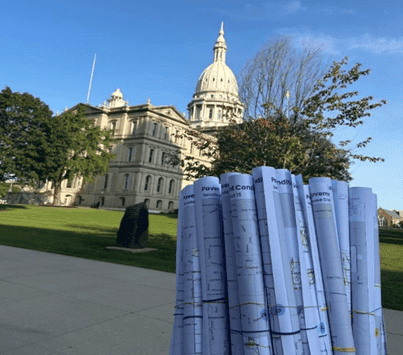
Additionally, during the State of Michigan’s budget process, SEMCOG staff provided pavement condition maps for every legislative district in Southeast Michigan with the goal of educating lawmakers about specific infrastructure challenges facing the communities they serve.
Since then, Governor Whitmer and the Michigan Legislature passed its Fiscal Year (FY) 2026 budget that totaled nearly $81 billion in spending for State government agencies. SEMCOG’s October Legislative Update outlines important components within the bill, including impacts on local government revenue sharing, K-12 and higher education, public safety, and transportation.
SEMCOG messaging has been consistent when it comes to local roads. Local road funding enhancements should not reduce local government revenue sharing, education funding, or any other critical revenue source for our members. In spite of this message – and tireless advocacy efforts by SEMCOG policy staff, lobbyists, and members – the State’s FY2026 budget will impact revenue sharing. The SEMCOG Government Affairs team is actively planning additional advocacy to ensure the stability of revenue sharing.
Boost in Statewide Transportation Investments
Although there is more work to be done, significant investments are being made to address critical infrastructure needs across Michigan.
The new budget allocates nearly $1.8 billion in ongoing resources for improving State and local roads when fully implemented over the next four years. This represents a nearly 16% increase in transportation investment funding from the previous budget. The FY 2026 transportation package invested $160 million into public transit, the largest infusion of money in history.
As a reminder, a majority of the revenue for Michigan’s publicly owned infrastructure is provided through the Michigan Transportation Fund (MTF), which is governed by Act 51. After deductions, 10% of the MTF is deposited in the Comprehensive Transportation Fund (CTF) for public transit. Remaining funds are then distributed to the state trunkline system, counties, and municipalities for road and infrastructure projects.
Learn more about MTF sources and distribution
Although the bill did not directly amend the text of Act 51, it did effect changes to how transportation funding is collected and distributed throughout the State.
Key elements include:
- Increases the motor fuel tax by 20 cents per gallon, and at the same time, exempts motor fuel from the 6% sales tax. This dedicates all the taxes paid at the pump go to transportation funding.
- Establishes a new wholesale excise tax on marijuana products, which is estimated to raise $420 million for roads in new revenue. Since the budget has been finalized, a lawsuit filed by the marijuana industry suggests the new tax violates the 10% tax established in the original ballot proposal which legalized marijuana in 2023. Depending on the outcome of the lawsuit, there could be an impact on the amount of tax being collected for roads. SEMCOG will continue to monitor this topic and share information with members as it becomes available.
- Michigan will decouple from federal business tax reductions that were undertaken in the Trump Administration’s One Big Beautiful Bill (OB3). While it is not a tax increase, the bill will slow down the tax decreases for businesses, with the $500 million gap going to roads.
- State law currently links the gas tax rate to registration fees for electric vehicles. For every cent the gas tax exceeds 19 cents per gallon, the registration fee increases by $5 for EVs and $2.50 for plug-in hybrids. Since the gas tax has increased by approximately 20 cents in the roads package, updated EV fees are expected to bring in another $11 million in revenue.
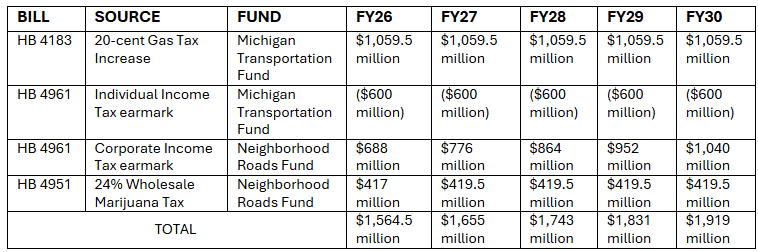
Below is summary of the funding estimates for FY 26 – FY 30:
The Michigan Department of Transportation (MDOT) developed estimates for Fiscal year 2026 increases in funding from PA 22 and estimates for fiscal year 2027:
Other items of interest included in the bill:
- The budget allocates (one-time) $7.65 million in funding from the MTF and State General Fund for a pilot program to study road usage charges (RUCs). Led by MDOT, this study will gather data and public feedback to assess the feasibility of a per-mile user fee.
- The Movable Bridge Fund supports the operation of publicly owned movable bridges in Michigan. The new bill expands the eligibility to allow remaining funds to be utilized to cover the costs of local federal bridge inspections and load analysis, if no other funding sources exist.
- $5.3 million in one-time funding for maritime and ports. This goes to the Maritime and Port Fund and is available for grants and the Detroit-Wayne County Port Authority is eligible.
- $5.3 million in one-time funding for a statewide network of nonmotorized trails and their maintenance.
New Neighborhood Roads Fund
SEMCOG’s current data shows that approximately 49% of neighborhood roads in the region are in poor condition. These roads are not eligible for federal-aid funding, and with limited resources and competing priorities, they are often not maintained properly.
The new bill works to address this issue by creating a Neighborhood Roads Fund (NRF), which is designed to ensure that local roads receive dedicated financing for repairs and maintenance. The purpose of the fund is for the preservation, maintenance, and repair of neighborhood roads. The NRF will receive approximately $1.1 billion in FY 2026 and steadily increase to approximately $1.5 billion by FY 2030.

*Dollar values included in the chart are estimates
Revenue in the NRF will be distributed as follows:
- $65 million to the Infrastructure Projects Authority Fund (IPAF). More included on this fund below.
- $100 million to an account for the repair of closed, restricted, and critical bridges, as determined by the local bridge advisory board.
- $40 million to the Local Grade Separation Fund.
- $35 million to the CTF (transit).
- Of any remaining funds:
- 20% will go to the State Trunkline Fund (STF)
- Of the remaining 80%:
- 65% to county road commissions (per section 12 of Act 51)
- 35% to city and village road agencies (per section 13 of Act 51)
- 20% will go to the State Trunkline Fund (STF)
Per Senate Bill 578, matching funds will not be required from a local unit of government or county road commission as a condition for expending money distributing these funds; however, any governmental entity expending these funds may request matching funds from other sources.
Historic Support for Public Transit
In Michigan, 78 local bus agencies operate in all 83 counties. Demand for reliable and affordable access to transit continues to be a priority for residents of all ages and abilities. More than 280,000 households in Michigan do not own a car, including nearly 153,000 households in Southeast Michigan, making this support significant for the populations that rely on these services every day.
Investing in public transportation is crucial for the local and State economy. Transit creates and improves access to jobs, fosters business growth and social equity, reduces costs, congestion, and emissions. The new Michigan budget includes nearly $160 million more in funding for public transit – including both bus operating and transformational projects. This funding will support local bus operations, enhance service, and invest in transit infrastructure, connecting more communities and people to the places they need to be.
A few key components include:
- Local Bus Operations – The funding includes $95 million for local bus operating costs, increasing funding for this area. It is important to note that this is not contingent on farebox recovery thresholds. This came from the additional revenue generated from the increasing the gas tax and eliminating the sales tax on gas, resulting in these funds being part MTF/CTF formula funding. In other words, this is not a “one-time” investment- this is now the baseline.
- Infrastructure Projects – As part of the NRF, an additional $65 million annually, or $325 million over five years, is designated for transformational infrastructure projects to build, expand, and enhance public transit systems through the newly created Infrastructure Project Authority Fund (IPAF). This could include expansion of current lines, big and small, such as more express buses.
- Increased Service – The increased investment will ultimately result in more buses, expanded service, and improved reliability for transit riders across the state which, as a result, will support the economy and provide better access to core services including health care and education.
There is still much to learn about the full scope and impact of the FY26 State budget. SEMCOG will continue to advocate on behalf of our member agencies for the best outcome for the communities in Southeast Michigan. We look forward to working with our local, county, and State partners to implement crucial transportation projects that improve mobility, enhance resiliency, and, most importantly, make our roadways safer for all users.
One response to “Update on Neighborhood Roads Fund and Transit in Michigan”
Posted by Roger
The information provided above states the neighborhood fund will be reserved for preservation and maintenance. Let’s hope so. Currently, overpayments for pensions and equipment rentals lopped off the top of the 90 percent Act 51 requires to be spent on roads doesn’t leave much left for meaningful road preservation. Further, many road commissions use MCL 247.662(15) as a tool to bilk townships into raising road taxes stating the statute requires them to do so. Obviously they conveniently leave out MCL 247.660(c). The other part of this new money that concerns me is giving the road commission discretion on what local roads get funded – unfortunately too much cronyism still exists in these road commission agencies. Giving them additional money without stringent guidance on allocations is necessary.
Posted on December 5, 2025 at 7:43 pm