
When there is an endemic of unfilled jobs across the economy, we all feel it. Over the last year, we’ve seen and experienced many symptoms of the national worker shortage. Restaurants are limiting service to online or carryout only; patients are experiencing longer waits for procedures; and schools are eliminating bus services or transitioning to remote learning due to lack of teachers and other staff.
The pandemic has made a huge and sudden impact on these outcomes, but it has also clarified and accelerated pre-existing trends. Demographic, economic, cultural, and employment issues that impact labor force availability and participation rates are vexing community and economic developers across the country.
Whether we are gazing at the Now Hiring signs while waiting in long check-out lines or adjusting to reduced hours, service, or closures, a need for workers is felt not only in the GDP but also in quality of life and prospects for future growth.
The participation gap affects both current openings and the future talent pipeline. In some cases, raising wages or paying sign-on bonuses may help temporarily, but broader labor force challenges need to be addressed through a comprehensive and collaborative approach led by government; employers and the business community; education providers; and workforce development officials.
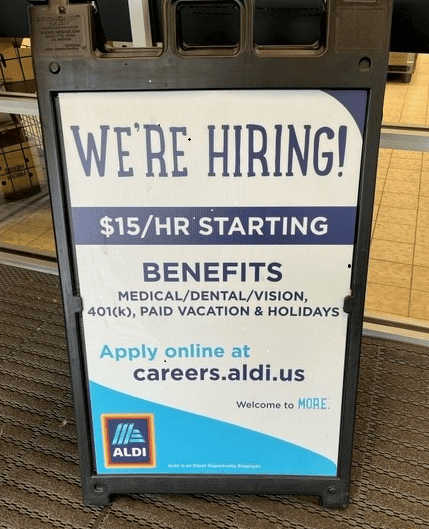
Hiring signs can be seen advertising opportunities in all sorts of jobs. So what is happening?
Demographic Trends
Southeast Michigan is undergoing a perfect storm. Our population is aging; birth rates are declining; there is a decline in immigration, resulting in a smaller traditional labor force and fewer workers available for the jobs that exist – as well as those that could be created here – if we had the necessary workforce.
Economic Trends
Worker shortages, health concerns, and supply chain disruptions are slowing down full recovery of the economy. In addition, increasing technology in most key industries, more online and delivery models in retail; telehealth and outpatient services in healthcare, and transformation of the auto industry to electric vehicles all require updated skillsets that are not currently available in the numbers required.
Employment Trends
As more baby boomers retire and millennials and Generation Z make up more of the working age population, they have a huge influence in the workplace. Their desire for “work/life balance” was not always met, but this is changing as employers recognize the need to retain employees in an employee’s market.
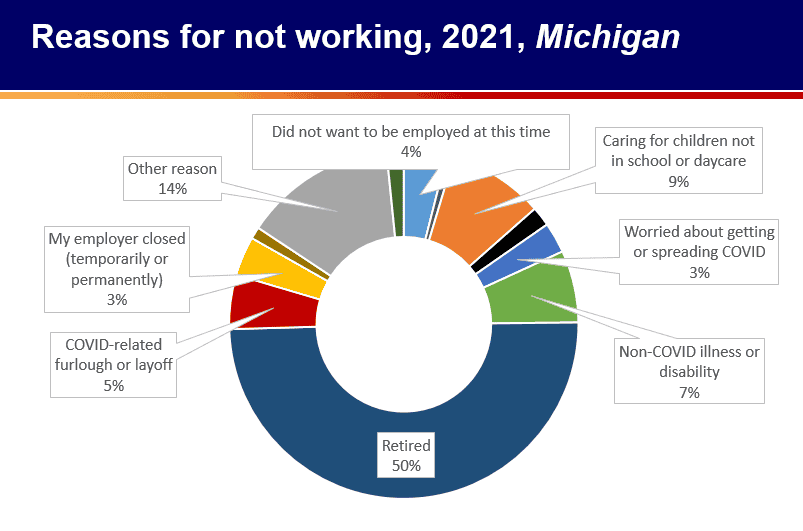
The “Great Resignation” has been used to describe the impact of the pandemic on how people rethink their careers. More workers than ever are looking for alternate careers that offer more flexibility, professional development or a different (more inclusive) culture. In addition, many people decided to bring forward their retirement plans. The number of baby boomers who retired in 2020 was greater than the eight previous years. The Census Bureau’s Household Pulse Survey asked why people are not working. These reasons are highlighted in the graphic below.
More than 136,000 women in Michigan left the workforce in 2020 – a nearly 6% decline. Many have yet to return. Major factors impacting women include family commitments, concentration in industries that were most impacted by the pandemic, and the availability of affordable quality childcare. Childcare costs are prohibitive for many households with an average annual cost of $9,000 in Michigan.
The perception of many in-demand careers as being less desirable is exacerbating the problem. Many skilled trade positions and occupations that do not require a four-year degree are going unfilled despite huge demand and employer’s offering paid training through apprenticeships and flexible work arrangements. There has been a decline in college enrollment, particularly in community colleges, during the pandemic. However, college remains the most desirable path toward career success for many people.
Another major employment trend that emerged during the pandemic is the huge increase in remote work. Since more than half of the workforce in the region was remote in 2020, both employers and workers have seen the advantages of remote work. Many employees are now making career decisions based on the availability of remote or hybrid arrangements in the future.
So how can we address worker shortages?
There are no magic bullets or easy solutions to addressing labor shortages. Ultimately, the solution lies in developing collaborative strategies that recognize the needs and challenges faced by workers and job seekers, families, employers, education and government. While childcare, health concerns, need for flexibility and work-life balance are some common themes affecting worker decisions, it is in the best interests of employers to partner with education and labor to develop in-demand skillsets and to provide a working environment and benefits that attract and retain workers during this period of labor shortages and into the future. Employers can also partner with workforce development agencies such as Michigan Works! These agencies can offer essential supports such as childcare and transportation assistance which can mean the difference between a workers ability to continue working or having to leave the workforce.
Local strategies that are making an impact include:
- Reduce cost of college tuition and associated costs of student life.
- Provide more flexibility in education and training programs to encourage more working adults and non-traditional workers to make the commitment to pursue in-demand careers.
- Create pre-apprenticeship and apprenticeship programs that provide paid training opportunities.
- Provide flexible working arrangements to enable workers to rejoin the workforce.
- Enhance career exposure and exploration among students to help grow the future labor force.
- Incorporate work readiness into education programs.
- Provide funding to cover the costs of books, supplies and other related expenses to encourage adults in training and education programs to complete their studies and enter or re-enter the workforce.
Additional SEMCOG/MAC Resources for Education and Workforce Development
- New Future of Education and Workforce
- Remote Work in Southeast Michigan Before and During COVID -19
- Increasing Shared Prosperity for a Resilient Economy, Comprehensive Economic Development Strategy for Southeast Michigan
- Future Skills: Preparing for the Changing World of Work
Leave a Reply